
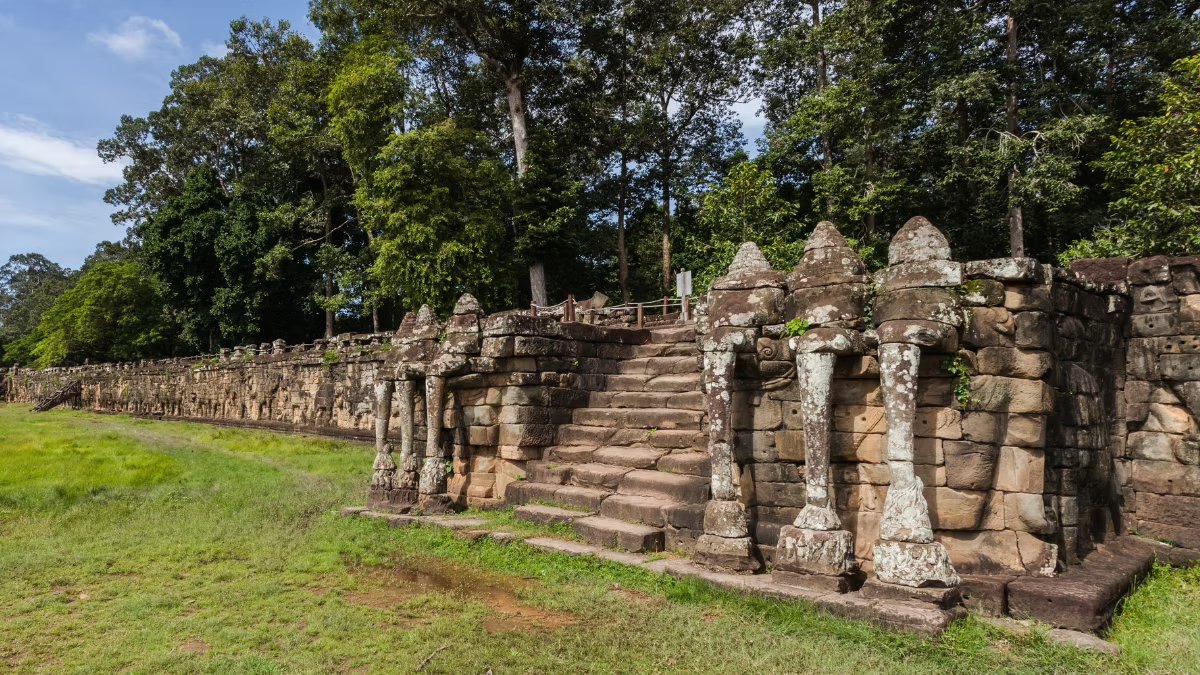
Terrace of the Elephants & Terrace of the Leper King — Visitor Guide

The Terrace of the Elephants is a 300-metre-long elevated stone reviewing platform on the western edge of Angkor Thom’s Central Square — the royal ceremonial stage from which the Khmer king watched parades, games, and public events. The Terrace of the Leper King is immediately to its north — a smaller elevated platform named after a weathered statue found on top. Both are covered in excellent bas-reliefs. The Terrace of the Leper King’s inner trench, which reveals an earlier buried terrace with carvings in exceptional condition, is one of the most compelling and least crowded experiences in the entire Angkor complex. Both are included in the Angkor Pass.
Most visitors to Angkor Thom walk past the terraces on their way between Bayon and their next stop, pausing briefly and moving on. This is understandable — after the face towers of Bayon, everything else can feel anticlimactic. But the terraces reward a slower visit, particularly the inner trench of the Terrace of the Leper King, which offers a quality of carved stone and a sense of discovery that no other part of Angkor Thom can match.
Top Tickets
The Terrace of the Elephants
What It Is
The Terrace of the Elephants is a 300-metre-long elevated stone platform — approximately 3.5 metres above the level of the Central Square — running north-south along the western edge of the square. It was the principal ceremonial viewing structure of the Khmer capital: the platform from which the king, his court, and military commanders watched the activities of the public space below.
What happened on the Central Square: Zhou Daguan, the Chinese envoy who visited Angkor in 1296–1297 CE, described the Central Square filled with military parades, ceremonial processions, athletic competitions, and public celebrations. The king and court watched from this terrace; the common people filled the square below.
The Elephant Bas-Reliefs
The terrace walls are covered with bas-reliefs — the elephant imagery that gives the terrace its name running in three continuous rows on the outer face. The elephants are shown life-sized or larger, their trunks extending downward, flanked by mahouts (elephant drivers) and naturalistic jungle vegetation. The treatment is less stylised and more naturalistic than most Angkor bas-relief work — the individual elephants have distinguishable features.
The three-headed elephant: The god Indra’s vehicle, Airavata — a mythological three-headed elephant — appears multiple times along the terrace. Each head is carved identically, with the three trunks grasping lotus flowers.
The garudas: Running along the terrace wall behind the elephants, rows of garuda figures (half-man, half-eagle beings from Hindu mythology) stand with their wings spread. They appear to support the terrace platform above them.
The Three Projection Stairways
The terrace extends three projection platforms toward the Central Square, each with staircases flanked by lion and garuda guardian figures. The central projection is the grandest — its staircase is broader, its guardian figures more numerous, and its approach more formally ceremonial than the north and south projections.
Photographically: The most useful view of the Terrace of the Elephants for understanding its scale is from the Central Square, standing back from the main projection and looking west — the elephant reliefs, the garudas, and the upper platform are all visible simultaneously.
The Terrace of the Leper King
What It Is
Immediately north of the Terrace of the Elephants, the Terrace of the Leper King is a slightly smaller elevated platform whose function is debated. It may have been a cremation platform for royalty, a platform for specific ceremonies, or a viewing area adjacent to the main terrace.
The statue: The terrace takes its name from a seated male figure found on top — a naked, cross-legged figure with no inscriptions. Its surface was heavily weathered and lichen-covered, leading early European observers to interpret the texture as leprosy. Later scholarship suggests the figure may represent Yama, the God of Death, or possibly a Khmer king. The figure on top is now a replica; the original is in the National Museum of Cambodia in Phnom Penh.
The Inner Trench — The Unmissable Feature
The most compelling feature of the Terrace of the Leper King is invisible from the main approach. A narrow trench runs along the inner face of the platform, revealing an earlier, buried terrace wall — the original face of a previous structure that was covered when the visible outer terrace was built over it. Walking the inner trench puts you between two carved walls, with an inner wall of divinities, nāga figures, and mythological scenes facing you at close range in a narrow corridor. The carvings on the inner wall are in extraordinary condition — protected from weathering by their burial for centuries.
How to access the inner trench: From the main terrace approach, walk to the north end of the Terrace of the Leper King and look for the entrance to the trench running south along the platform’s inner face. The trench is approximately 1.5 metres wide and 3 metres deep — a narrow corridor between the new outer wall and the buried old wall.
What you see in the trench: The inner (buried) wall carries carved figures in high relief — seated divinities, nāga figures with multiple heads, and rows of apsaras in remarkably fine condition. Because these carvings were covered and protected for centuries after the outer terrace was built over them, they show almost none of the surface deterioration visible on the outer terrace reliefs. Walking the full length of the trench (approximately 80 metres, turning two corners) takes 10–15 minutes.
Why almost nobody goes here: The inner trench is not well-signed and is not mentioned in many guidebooks. Most visitors on guided tours do not enter it. If you arrive at the Terrace of the Leper King and see no queue for the trench entrance, that is entirely normal.
Visiting Both Terraces — Practical Guide
Access: Both terraces are on the western edge of Angkor Thom’s Central Square, immediately north of the main entrance road from the South Gate. They are typically visited as part of an Angkor Thom day after Bayon and Baphuon.
Time required: The Terrace of the Elephants can be walked in 20–30 minutes. The Terrace of the Leper King (including the inner trench) takes 20–30 minutes. Allow 45–60 minutes for both.
Best time: Morning (8:30–11:00 AM) for the best light on the east-facing reliefs. Both terraces are open areas without tree cover, so midday heat is significant in the warm season.
Frequently Asked Questions
Why is it called the Terrace of the Elephants?
Because of the rows of life-sized elephant bas-reliefs that line the main terrace walls — the most distinctive decorative element of the structure.
Why is it called the Terrace of the Leper King?
The name comes from a statue found on top — a seated figure with heavily weathered, lichen-covered skin that was misinterpreted as leprosy by early European scholars. The figure is now believed to represent Yama (God of Death) or a Khmer king.
What is the inner trench at the Terrace of the Leper King?
A narrow corridor between the outer terrace wall and a buried earlier terrace wall. Walking it reveals carved reliefs in extraordinary condition — protected for centuries by their burial. It is one of the most compelling discoveries at Angkor for visitors who find it.
Are the terraces included in the Angkor Pass?
Yes. Both terraces are inside Angkor Thom and are included in the standard Angkor Pass.
