
Angkor Thom — Complete Guide to the Ancient Khmer Capital

Angkor Thom (“Great City”) is the last and greatest capital of the Khmer Empire, built in the late 12th century by Jayavarman VII. It covers approximately 9 square kilometres, enclosed by an 8-metre-high wall and a 100-metre-wide moat, and entered through five monumental gates. Inside, the key attractions are Bayon Temple (the face-tower temple at the city’s geometric centre), Baphuon, Phimeanakas, the Terrace of the Elephants, and the Terrace of the Leper King. All are included in the standard Angkor Pass.
Angkor Thom is where the Khmer Empire’s power becomes comprehensible at its true scale. Angkor Wat is extraordinary — but it is one building. Angkor Thom is an entire city of approximately 150,000 people at its height, surrounded by military walls that rival anything in medieval Asia, and packed with temples, palaces, ceremonial terraces, and administrative structures.
The fact that most of this city was built in wood — and has therefore vanished — makes what remains (in stone) all the more impressive as a fraction of the whole.
Top Tickets
Essential Facts
| Feature | Detail |
|---|---|
| Location | 1.7 km north of Angkor Wat |
| Built | Late 12th century (c.1190s CE) by Jayavarman VII |
| Area | Approximately 9 sq km within the walls |
| Wall dimensions | 8 metres high, 3 metres thick; 12 km perimeter |
| Moat | 100 metres wide, surrounds all four sides |
| Gates | 5 (South, North, East, West, Victory Gate) |
| Key temples | Bayon, Baphuon, Phimeanakas |
| Key structures | Terrace of the Elephants, Terrace of the Leper King |
| Entry | Included in Angkor Pass |
The Five Gates
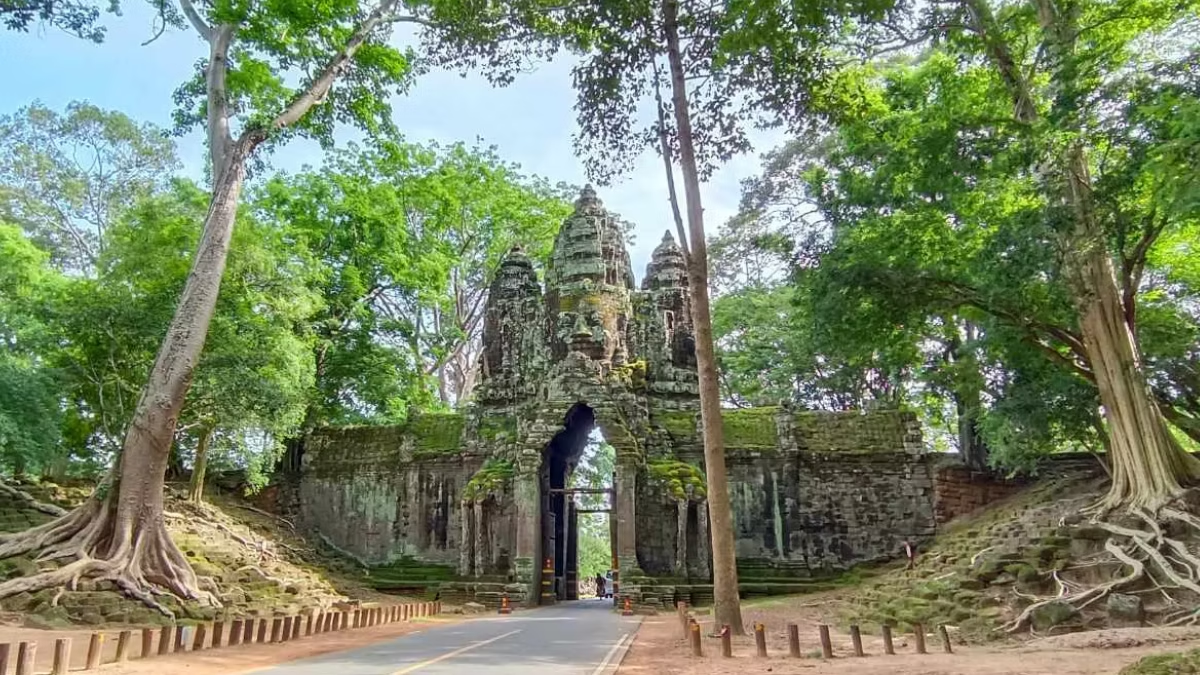
Each gate of Angkor Thom is a monumental tower carved with four giant faces — one looking in each cardinal direction — echoing the face towers of Bayon at the city’s centre. The gates are approached by causeways flanked by rows of stone figures: 54 gods on one side, 54 demons on the other, each holding the body of a nāga serpent — a reference to the Churning of the Ocean of Milk.
South Gate: The most used and most photographed gate. Most visitors arrive from Angkor Wat via tuk-tuk and enter Angkor Thom through the South Gate. The causeway statues here are largely reproductions — the originals were removed to prevent further deterioration — but the gate tower itself is original and well-preserved.
Victory Gate (East): Used historically for royal processions and returning armies. Also used by visitors approaching from Ta Keo or Banteay Kdei on the Small Circuit.
North, West, and Dead Gates: Less visited. The Dead Gate (south of the East Gate) has a separate causeway with notably different guardian figures from the other gates.
Climbing the gates: It is not possible to climb the gate towers — they are sealed.
Bayon Temple — The City’s Sacred Centre
Bayon sits at the exact geometric centre of Angkor Thom. It is the state temple of the city — the place where the divine presence of the Bodhisattva Avalokiteshvara (embodied by Jayavarman VII) presided over the capital. With 54 towers and 216 giant smiling faces, it is the most visually distinctive temple in the Angkor complex and one of the most photographed in the world.
See the full Bayon Temple guide for complete detail.
Baphuon Temple
Baphuon is a large temple mountain predating Angkor Thom — built in the 11th century under King Udayadityavarman II — that Jayavarman VII incorporated into his new capital when he built the walls around it. It is dedicated to Shiva and originally represented Mount Meru in Hindu cosmology.
The restoration story: Baphuon underwent one of the most extraordinary archaeological restorations in history. The French École française d’Extrême-Orient (EFEO) dismantled the entire structure in the 1960s to rebuild it stone by stone — then the Cambodian civil war forced the French team to flee, and the records of which stone went where were lost. The EFEO resumed the work decades later using the remaining stones, historical photographs, and educated inference. The restoration was completed in 2011.
The reclining Buddha: On the western face of Baphuon, a large reclining Buddha figure was carved into the collapsed gallery stones — probably in the 15th century as the temple was converted from Hindu to Buddhist use. It is 70 metres long and is visible only from a distance (standing back from the western approach).
The long causeway: Baphuon is approached from the east by a 172-metre elevated causeway on round columns — an unusual Khmer architectural feature. The view of Baphuon from the end of this causeway is one of the most arresting in Angkor Thom.
Phimeanakas (The Celestial Palace)
Phimeanakas is a small pyramid temple inside the Royal Palace enclosure, built in the late 10th century and subsequently modified by later kings. The name means “Celestial Palace” in Sanskrit. Chinese envoy Zhou Daguan, who visited Angkor in 1296–1297 CE, wrote that the king slept at the top of the Phimeanakas tower each night, where he would consort with a nāga goddess before descending to his wives. The tower is accessible and provides views over the surrounding Royal Palace enclosure.
The Terrace of the Elephants
A 300-metre-long elevated stone terrace running along the western edge of the Central Square — the main public space of Angkor Thom. The Terrace of the Elephants was the reviewing stand from which the king and his court watched military parades, games, and public ceremonies taking place on the Central Square below.
The bas-reliefs: The terrace walls carry extensive bas-reliefs — the elephant imagery that gives the terrace its name (rows of elephants with their trunks extended), as well as garudas, nāgas, divine figures, and hunting scenes. The three-headed elephant (Airavata, vehicle of the god Indra) appears repeatedly.
The central platform: Three projection stairways extend from the main terrace toward the Central Square, each with lion and garuda guardian figures. The central projection is the grandest and most photographed.
The Terrace of the Leper King
Immediately north of the Terrace of the Elephants, the Terrace of the Leper King is a smaller but equally interesting elevated platform. Its name comes from a statue discovered on top — a seated male figure whose weathered, lichen-covered surface was misinterpreted by early scholars as depicting leprosy. The statue is now a replica (the original is in the National Museum in Phnom Penh).
The inner terrace: The most interesting feature of the Terrace of the Leper King is not visible from the main approach. A narrow trench runs along the inner face of the platform, revealing an earlier, buried terrace — an inner wall of carvings that was covered when the outer terrace was built. Walking this trench puts you between two carved walls, both with deities, nāgas, and mythological figures facing you at close range.
How to Visit Angkor Thom — A Recommended Sequence
Most visitors cover Angkor Thom in 3–4 hours as part of a day that also includes Angkor Wat:
- Drive from Angkor Wat: 10 minutes north, entering through the South Gate (stop at the gate for photographs).
- Bayon: 1.5–2 hours. Outer gallery bas-reliefs, upper terrace, face towers.
- Baphuon: 45 minutes. The long causeway approach, the pyramid, the reclining Buddha.
- Phimeanakas and Royal Palace: 30 minutes. A brief exploration of the Royal Palace enclosure.
- Terrace of the Elephants: 20 minutes. Walk the full 300-metre length, examining the bas-reliefs.
- Terrace of the Leper King: 20 minutes. The inner trench is essential.
- Exit north or east to continue to Ta Prohm (Small Circuit) or Pre Rup and the Grand Circuit.
Frequently Asked Questions
How long does it take to see all of Angkor Thom?
A thorough visit covering Bayon, Baphuon, the Terraces, and Phimeanakas takes 3–4 hours. Adding the South Gate arrival and the walk between sites, allow a full half-day (4–5 hours).
Is Angkor Thom bigger than Angkor Wat?
In total area, yes — Angkor Thom covers approximately 9 square kilometres within its walls, compared to Angkor Wat’s 162-hectare (1.62 km²) complex. But Angkor Thom is a city containing multiple structures; Angkor Wat is a single unified architectural complex.
What is the most important thing to see in Angkor Thom?
Bayon, unquestionably — the 216 face towers are the most visually striking feature of the entire Angkor complex. But the Terrace of the Elephants and the inner trench of the Terrace of the Leper King are both worth significant time that many visitors overlook.
