
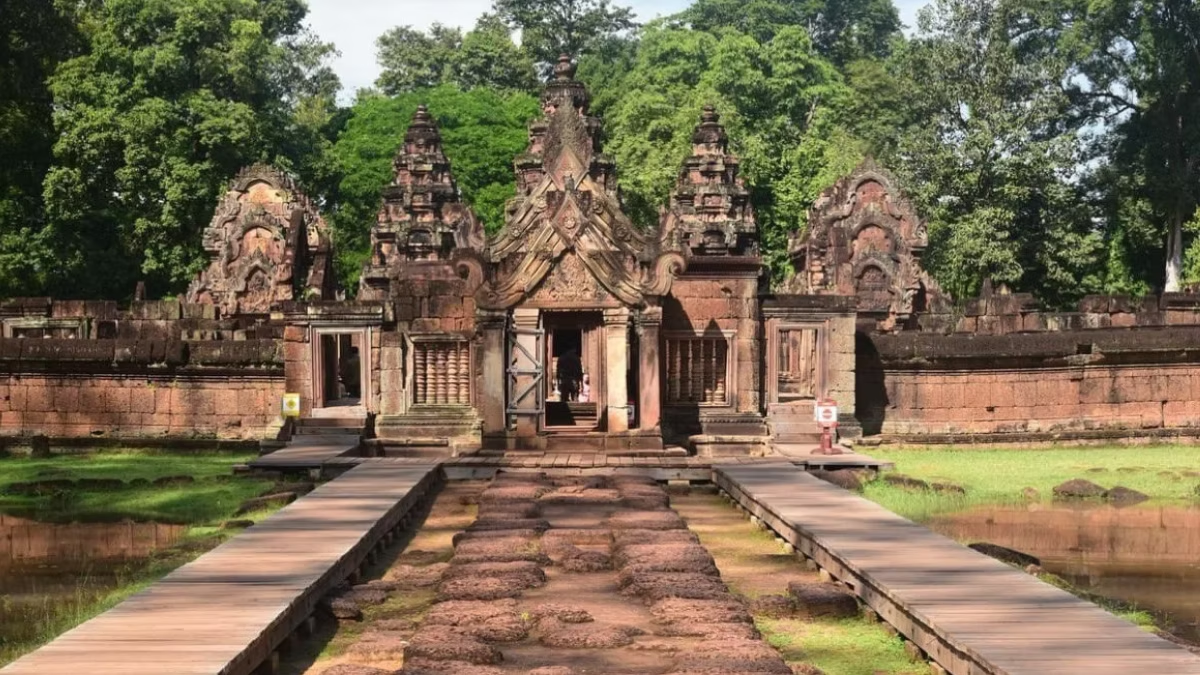
Banteay Srei Temple — Pink Sandstone & Fine Carvings Guide

Banteay Srei (“Citadel of Women”) is a 10th-century Hindu temple located 30 km north of Siem Reap, built in distinctive pink-red sandstone with carvings of exceptional depth and precision — considered by many scholars the finest decorative stone carving anywhere in the Khmer world. It is smaller than the main Angkor circuit temples but universally agreed to be among the most beautiful. It opens at 7:30 AM, closes at 5:30 PM, and is included in the Angkor Pass.
Every visitor who has spent two days exploring Angkor Wat, Bayon, and Ta Prohm arrives at Banteay Srei prepared, perhaps, to be merely impressed. The smaller scale — the entire central sanctuary area is roughly 100 metres by 100 metres — suggests a reduced experience. And then they step through the eastern gopura and see the carvings. The precision, the depth, the narrative detail, and the extraordinary preservation of the pink sandstone reliefs stop most visitors completely. Banteay Srei is not a lesser Angkor experience. For many visitors, it is the most purely beautiful temple on the entire circuit.
Essential Facts
| Feature | Detail |
|---|---|
| Location | 30 km north of Siem Reap |
| Built | 967 CE (pre-Angkor Wat by approximately 150 years) |
| Religion | Hindu (Shaivite — dedicated to Shiva) |
| Stone | Pink-red sandstone (harder than grey sandstone of main circuit) |
| Opens | 7:30 AM |
| Closes | 5:30 PM |
| Entry | Included in Angkor Pass |
| Travel time | 40–50 minutes by car from Siem Reap |
| Best time | Morning (8:00–11:00 AM) or late afternoon (3:00–5:00 PM) |
Why the Carvings Are Exceptional
The quality of Banteay Srei’s carvings is a function of two things: the material and the scale.
The pink sandstone: Unlike the grey sandstone used at Angkor Wat, Bayon, and most other Angkor temples, Banteay Srei is built from a harder, denser pink-red sandstone that allowed carvers to achieve far greater precision and depth. The material is also more resistant to weathering — the carvings at Banteay Srei are better preserved after more than a thousand years than most of the main circuit carvings despite being substantially older.
The smaller scale: Banteay Srei’s towers and walls are proportionally smaller than those at Angkor Wat, but the carving is proportionally denser. Where Angkor Wat’s outer gallery bas-reliefs are approximately 2 metres high, Banteay Srei’s decorative panels are carved at a scale that allows extraordinary detail in a smaller surface area — the mythological narratives in the pediments (the triangular elements above the doorways) are as complex as anything at Angkor Wat but compressed into compositions approximately one-third the size.
The result: When you look at Banteay Srei’s carvings up close, you can see individual feathers in a bird’s wing, the weave of a fabric, the expression of a specific face, the individual leaves of a stylised tree. This level of detail is not present at any other Angkor site.
What to See — The Key Elements
The three central prasats (tower shrines): The heart of Banteay Srei is a grouping of three pink sandstone towers — a central tower dedicated to Shiva and flanked by two slightly smaller towers. Access to the inner enclosure is restricted to protect the carvings — you view the towers from behind a roped perimeter — but the carvings on their exterior walls are visible in extraordinary detail at close range.
The pediments: Above each doorway, a triangular pediment (tympanum) carries a carved scene from Hindu mythology. These are the most complex and best-preserved narrative carvings at the site:
- East gopura pediment: Indra (god of rain) on a three-headed elephant, surrounded by torrential rain — a scene from the episode where Indra saves the world from drought
- Central prasat east pediment: The demon Ravana shaking Mount Kailasa with Shiva and Parvati seated on top — from the Ramayana
- Central prasat west pediment: Uma and Shiva on Mount Kailasa, with surrounding divine figures
- South tower pediments: Scenes from the legend of Durga and the buffalo demon Mahishasura
The lintel carvings: The horizontal elements above each doorway carry continuous decorative bands of stylised foliage, mythological creatures, and narrative scenes. The depth and precision of these carved bands — some as deep as 5 cm into a hard sandstone surface — is astonishing.
The guardian figures (dvarapalas): Stone guardian figures flank most of the major doorways. At Banteay Srei, these are carved with exceptional detail — faces, jewellery, and body armour all rendered with the same precision as the decorative panels.
The Famous André Malraux Theft (1923)
Banteay Srei has a colourful place in the history of cultural heritage crime. In 1923, the young André Malraux — later to become France’s Minister of Cultural Affairs — arrived at Banteay Srei with a small expedition, removed several carved stones from the pediments, and attempted to ship them to Paris for sale. He was arrested at Phnom Penh, tried in Siem Reap, and convicted — a conviction later suspended on appeal. The stones were returned to Banteay Srei. Malraux later drew on the Cambodian experience in his novel La Voie royale (The Royal Way). The incident prompted the French colonial administration to establish stricter heritage protection protocols for the Angkor sites.
Getting to Banteay Srei
By tuk-tuk: The 30 km drive north of Siem Reap takes approximately 45 minutes. The road to Banteay Srei is sealed and in reasonable condition. Tuk-tuk drivers add $10–15 to a standard Small Circuit fare for the Banteay Srei extension. Agree this in advance.
By private car: 35–45 minutes, significantly more comfortable than a tuk-tuk for the 30 km journey on a rural road. Recommended for visits during the hot season or for those with limited time.
By bicycle: Possible for fit cyclists who enjoy the independence — the full round trip from Siem Reap is approximately 70 km and requires a full day. Best in the cool season (November to February).
On a 2-day guided tour: Most Angkor 2-day tour packages include Banteay Srei on day two. See our 2-Day Tour guide for details.
Photography — Best Light and Positions
Morning (8:00–11:00 AM): The east-facing elements — the eastern gopura, the main entrance sequence, the central prasat east pediment — are in optimal morning light. The warm pink sandstone glows particularly well in this direction.
Late afternoon (3:00–5:30 PM): The west-facing elements come into the best light. The overall warmth of the late afternoon sun emphasises the pink-red tone of the stone beautifully.
Restricted access: You cannot touch the carvings or enter the inner enclosure beyond the restricted line. This is not merely a rule — the oils from human skin and the physical pressure of touching genuinely damage the carved surfaces. Respect this restriction absolutely.
Frequently Asked Questions
Why is Banteay Srei called the “Citadel of Women”?
The name “Banteay Srei” translates as “Citadel of Women” or “Citadel of the Ladies.” The name is modern — the original Khmer name is unknown. It is generally believed to refer to the extraordinary delicacy and precision of the carvings, which were attributed by early observers to female carvers (there is no evidence this was the case, but the attribution has persisted in the name).
Is Banteay Srei included in the Angkor Pass?
Yes. Banteay Srei is included in the standard Angkor Pass (1-day, 3-day, and 7-day). No separate ticket is required.
How far is Banteay Srei from Angkor Wat?
Approximately 31 km north of Angkor Wat — 40–50 minutes by car or private vehicle. It is not on the main Small or Grand Circuit routes and requires a dedicated side trip.
When is Banteay Srei least crowded?
Banteay Srei is significantly less crowded than the main circuit temples. Arriving before 10:00 AM or after 3:00 PM gives the best experience. Even at peak season midday, the crowds are a fraction of those at Angkor Wat.
