
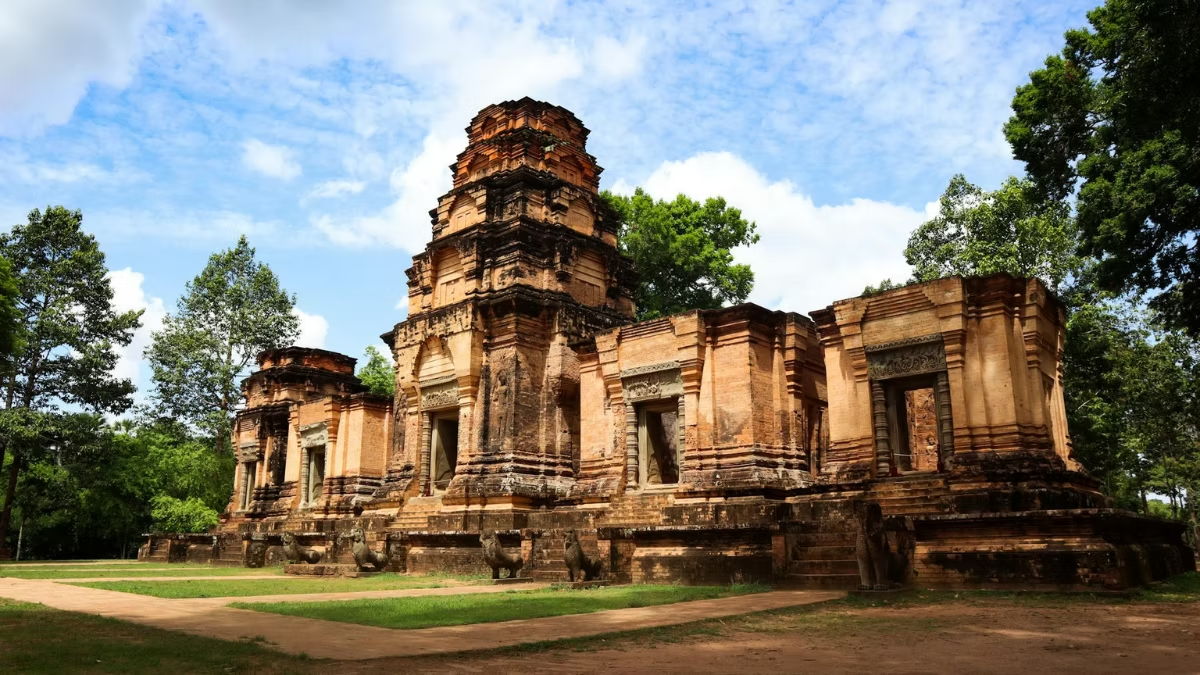
The Roluos Group Temples — Angkor’s Earliest Ruins Guide

The Roluos Group is a cluster of three 9th-century Khmer temples — Bakong, Preah Ko, and Lolei — located approximately 13 km east of Siem Reap, built during the earliest phase of Angkor-era Khmer civilisation under kings Indravarman I and Yasovarman I. They are the oldest major temple complex accessible from Siem Reap and predate Angkor Wat by more than 200 years. All three are included in the standard Angkor Pass. A half-day visit covering all three takes 2.5–3 hours.
The Roluos Group is where Angkor began. Before the kings moved their capital northwest to the Angkor plain proper, the earliest Angkorian kings built their temples and cities here — in a region then called Hariharalaya. The temples they left behind are architecturally simpler than Angkor Wat or Bayon, but they carry the DNA of everything that followed: the temple mountain form, the prasat tower arrangement, the decorative lintel programme, and the use of sandstone carving that would be refined over the following three centuries into the masterpieces of the main Angkor circuit.
Top Tickets
Essential Facts
| Feature | Detail |
|---|---|
| Location | 13 km east of Siem Reap (Roluos town) |
| Three main temples | Bakong, Preah Ko, Lolei |
| Period | 9th century (879–893 CE) |
| Dynasty | Early Angkorian — Indravarman I and Yasovarman I |
| Religion | Hindu (Shaivite) with some Vishnu elements |
| Entry | Included in Angkor Pass |
| Travel time | 15–20 minutes by car from Siem Reap |
| Best time | Morning (8:00–11:00 AM) |
The Historical Context
The Roluos Group represents the first phase of what we now call the Angkor period — the era when the Khmer kings established a stable capital and built the monumental temple complexes that would characterise the empire’s political theology for the next 500 years.
Indravarman I (reigned 877–889 CE): Built the first major irrigation infrastructure of the Angkor plain (the Indratataka baray, a large reservoir) and the first two Roluos temples: Preah Ko (879 CE) and Bakong (881 CE). He is often credited as the true founder of Angkor-era Khmer civilisation.
Yasovarman I (reigned 889–910 CE): Moved the capital northwest to the Angkor plain proper (founding Yasodharapura, of which Phnom Bakheng was the state temple), but returned to Roluos to build Lolei (893 CE) on an island in the centre of his father’s baray.
Temple 1: Bakong — The First Temple Mountain
Bakong is the most impressive of the three Roluos temples and the most architecturally significant — the first major Khmer temple mountain, establishing the quincunx tower arrangement that would culminate in Angkor Wat two centuries later. It is a five-tiered sandstone and laterite pyramid, 65 metres square at its base, with a central tower on the fifth tier and a series of smaller prasat towers around the lower levels. It opens at 7:30 AM and is the centrepiece of any Roluos Group visit.
What to see:
- The main pyramid: five tiers rising to the central sanctuary on the fifth level
- The eight brick prasat towers in the lower enclosure area — the earliest large-scale brick tower architecture in the Angkor region
- The decorative devata (guardian goddess) figures on the prasat tower faces — early examples of the decorative programme that would be perfected at Angkor Wat
- The large moat surrounding the outer enclosure (partially filled)
- The active Buddhist monastery within the outer enclosure — Bakong has had a resident monk community since at least the medieval period
The significance: Bakong’s five-tiered pyramid with central tower and surrounding brick towers is the direct architectural ancestor of Angkor Wat’s five-tower quincunx arrangement. Seeing Bakong makes Angkor Wat’s design logic immediately more comprehensible.
Temple 2: Preah Ko — The Sacred Bull
Preah Ko (“Sacred Bull”) is a modest-sized temple dedicated to Shiva, built in 879 CE by Indravarman I to honour his royal ancestors. It consists of six brick prasat towers arranged in two rows of three — a simple arrangement that is architecturally less dramatic than Bakong but carries extraordinary decorative detail in its lintel carvings and false-door decorations. The name refers to a sculpture of Nandi (Shiva’s sacred bull) that once guarded the entrance.
What to see:
- The six brick tower prasats in two rows — the eastern row taller and dedicated to male ancestors, the western row shorter and dedicated to female ancestors
- The lintel carvings: among the finest early Angkorian carving in the region, the lintels of Preah Ko show the earliest developed examples of the decorative programme that characterises later Angkor architecture — Indra on his three-headed elephant, Kama on a hamsa bird, and various other divine figures
- The stucco decoration: the brick towers were originally covered in stucco plaster — much of this has fallen, but remnant sections still show the extraordinary three-dimensional figurative decoration that transformed plain brick into elaborate carved surfaces
- The false doors: each prasat has three false doors (sealed stone doorways) for every real one. The false doors carry carved dvarapalas (guardian figures) in excellent condition
The Sanskrit inscriptions: Preah Ko carries the oldest major Sanskrit inscriptions from the Angkor period. They record Indravarman I’s royal genealogy, his religious dedications, and the identities of the divine beings installed in each prasat tower.
Temple 3: Lolei — The Island Shrine
Lolei was built in 893 CE by Yasovarman I on an artificial island in the centre of the Indratataka baray — a large reservoir built by his father. The baray has been dry for centuries, and Lolei now sits in the middle of a village rather than surrounded by water. It consists of four brick prasat towers arranged in a two-by-two grid, similar in decorative programme to Preah Ko but smaller. An active Buddhist monastery has operated here since the medieval period.
What to see:
- The four brick prasat towers — partially collapsed but with carvings in good condition
- The decorative lintels, similar in style to Preah Ko but slightly later in date — a useful stylistic comparison
- The active Buddhist monastery within the enclosure — the contrast of medieval Hindu brick towers and contemporary Cambodian Buddhist monastic life is characteristic of the Roluos Group’s living quality
The atmospheric context: Unlike the main Angkor circuit temples, Lolei is embedded in a working village and monastery. Monks go about their daily activities, children play in the surrounding area, and the temple exists as a living part of the community rather than an isolated heritage site. This gives it an atmosphere distinct from any of the main circuit temples.
How to Visit the Roluos Group
Transport: 15–20 minutes east of Siem Reap by car or tuk-tuk on Route 6. Most tuk-tuk drivers know the route; confirm the driver knows all three temples before departing.
Sequence: Bakong first (the most impressive), then Preah Ko (a 5-minute drive north), then Lolei (2 minutes further). The sequence can be done in either direction.
Time required: A thorough visit of all three temples takes 2.5–3 hours. A highlights-only visit takes 1.5–2 hours.
Combining with other sites: The Roluos Group is most naturally combined with a Siem Reap city visit (the Angkor National Museum, Artisans Angkor, the Old Market area) for a full day, or as a morning excursion before an afternoon at the main Angkor circuit temples.
Frequently Asked Questions
Is the Roluos Group included in the Angkor Pass?
Yes. All three Roluos Group temples — Bakong, Preah Ko, and Lolei — are included in the standard Angkor Pass (1-day, 3-day, and 7-day).
Are the Roluos temples as impressive as Angkor Wat?
No — they are much smaller and architecturally simpler. Their value is historical and contextual: seeing the Roluos Group temples helps you understand where the Angkor Wat design tradition came from and how it evolved. Visitors who visit Roluos before the main circuit temples consistently report that Angkor Wat makes more sense afterward.
How far is the Roluos Group from Angkor Wat?
Approximately 18 km east of Angkor Wat and 13 km east of Siem Reap.
When is the best time to visit?
Morning (8:00–11:00 AM) — before the midday heat and before whatever other visitors arrive (though the Roluos Group is never crowded).
