
Angkor Wat Itinerary — 1 Day, 2 Days & 3 Days (2026 Guide)

For one day at Angkor Wat, cover the Small Circuit: sunrise at Angkor Wat (5:00 AM), explore the main temple until 10:00 AM, then Angkor Thom and Bayon, then Ta Prohm, finishing at Phnom Bakheng for sunset. For two days, add the Grand Circuit on day two. For three days, add an outlying temple excursion — Banteay Srei, Beng Mealea, or Koh Ker — on day three. Start every day before 8:00 AM to beat the heat and the crowds.
Planning your Angkor Wat itinerary is one of the most rewarding parts of preparing for a Cambodia trip — and one of the most confusing, given the scale of the park and the number of temples competing for your attention. This guide gives you tested, practical itineraries for every day count, with honest timing, transport advice, and guidance on what to prioritise if time is short.
Top Tickets
Before You Start: Essential Logistics
Buy your Angkor Pass the day before — this avoids morning queuing and lets you head directly to the temples. The 3-day pass ($62) is the best value for 2–3 day visits and does not require consecutive days. See our Angkor Pass guide for full details.
Arrange transport the night before — book a tuk-tuk through your guesthouse and agree on departure time and itinerary. For sunrise, this means departing Siem Reap by 4:30–4:45 AM.
Check the dress code — shoulders and knees must be covered. Pack accordingly.
Start early every day — the heat and crowds both peak between 10:00 AM and 2:00 PM. The first two hours of the day and the last two hours are consistently the best.
1-Day Angkor Wat Itinerary
This itinerary covers the three headline temples of the Small Circuit. It is full and tiring but achievable.
4:30 AM — Depart Siem Reap by tuk-tuk. If you have not yet bought your Angkor Pass, your driver will stop at the ticket office (open from 4:30 AM).
5:00–5:15 AM — Arrive at the north reflecting pool at Angkor Wat. Position yourself on the northern bank for the sunrise reflection shot. The sky begins to lighten around 5:30 AM; the sun clears the towers between 5:45 and 6:15 AM depending on season and cloud cover.
6:30 AM — Move from the reflecting pools to the main western entrance and begin exploring the temple interior. Start with the outer bas-relief galleries — the south gallery Army of Suryavarman II and the east gallery Churning of the Ocean of Milk are the highlights. Allow 45–60 minutes for the full bas-relief circuit.
8:00 AM — Climb to the second level and then to the upper sanctuary (steep stairs; remove shoes at the inner sanctuary entrance). Allow 45 minutes at the upper level. Views over the Angkor plain are exceptional in the morning light.
9:30 AM — Return to your tuk-tuk. Depart for Angkor Thom (5-minute drive). Enter via the South Gate — walk across the causeway flanked by 54 gods and 54 demons before entering the ancient city.
10:00 AM — Bayon Temple. Allow 1.5–2 hours. The famous stone faces are best photographed in the morning light. Explore the ground level galleries and, if energy allows, climb to the upper terrace for views over the face towers.
11:30 AM — Optional: Walk to Baphuon (600 metres north of Bayon) and the Terrace of the Elephants. Allow 30–45 minutes for both.
12:30 PM — Lunch break. Restaurants are located along the road between Angkor Thom and Ta Prohm. Rest in air-conditioned comfort for 1–1.5 hours — this is not wasted time, it is essential recovery in the midday heat.
2:00 PM — Ta Prohm. Allow 1.5 hours. The famous tree roots engulfing the stone galleries are extraordinary — take your time here rather than rushing. The most photographed spots (the large Tetrameles trees whose roots split the galleries) have signposted viewing areas.
3:30 PM — Return to Angkor Wat if you want to photograph the western façade in the late afternoon golden light (5-minute drive). The main façade faces west and is beautifully lit from 3:30–5:30 PM. This is also a significantly quieter time at the temple.
4:00 PM — Depart for Phnom Bakheng (1.3 km from Angkor Wat). Arrive by 4:15 PM for the 25-minute walk to the summit. The strict 300-person capacity is enforced — arriving by 4:30 PM during peak season is essential. Sunset from the summit, with Angkor Wat visible in the distance over the jungle canopy, is spectacular.
6:30 PM — Return to Siem Reap for dinner.
What you will miss on 1 day: Banteay Kdei, Srah Srang, the Grand Circuit temples (Preah Khan, Neak Pean, Ta Som, Pre Rup), Banteay Srei, and all outlying temples. See our How Many Days guide for a frank assessment of whether 1 day is enough.
2-Day Angkor Wat Itinerary
Day 1 follows the 1-day itinerary above. Day 2 covers the Grand Circuit and Banteay Srei.
Day 2: Grand Circuit + Banteay Srei
6:30 AM — Depart Siem Reap. Head directly to Preah Khan — one of the most atmospheric temples in the park and far less crowded in the early morning than the main circuit sites.
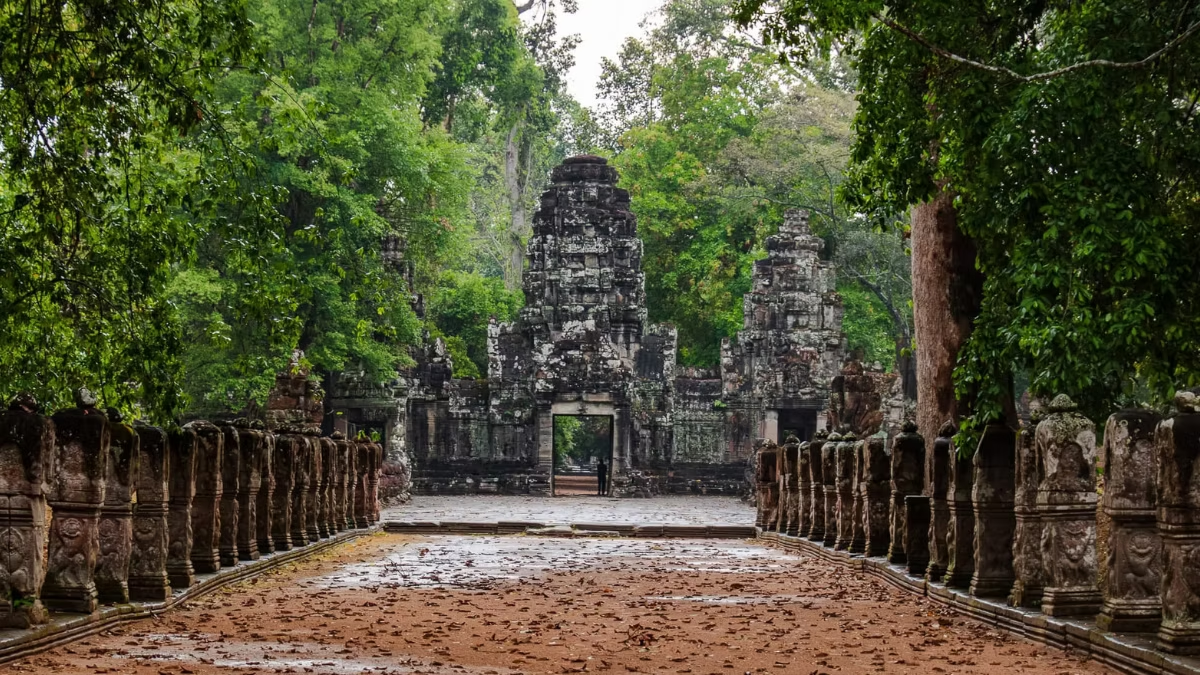
7:00–9:00 AM — Preah Khan. Allow 2 hours. This sprawling temple rewards slow exploration — long corridors, mossy stones, and occasional vast fig trees growing through the walls. Walk the full east-west axis and explore the two-storey round-columned structure (the only one of its kind at Angkor).
9:15 AM — Neak Pean (10-minute drive). The island temple in a large reservoir. Allow 30–45 minutes.
10:00 AM — Ta Som (10-minute drive). Small but atmospheric — the eastern gopura is engulfed by a massive fig tree in a composition almost as dramatic as Ta Prohm. Allow 30–45 minutes.
10:45 AM — Eastern Mebon (15-minute drive). A pyramid temple originally surrounded by water (the reservoir is now dry). Good views from the upper tier. Allow 45 minutes.
11:30 AM — Pre Rup (10-minute drive). A pyramid temple with elevated terraces — excellent for views over the surrounding jungle and a popular sunset alternative to Phnom Bakheng. Allow 45 minutes.
12:30 PM — Lunch. Find a restaurant near the Grand Circuit road or return towards Siem Reap for more options.
2:00 PM — Depart for Banteay Srei (30 km north; 40–50 minutes by tuk-tuk or car). Note: the additional distance to Banteay Srei will add to your tuk-tuk cost for the day — agree this in advance.
3:00–4:30 PM — Banteay Srei. Allow 1.5 hours. The finest Khmer carvings in the world, executed in deep-red sandstone. Even after two days of temples, Banteay Srei is extraordinary — the level of detail in the decorative panels is unlike anything else at Angkor.
5:30 PM — Return to Siem Reap.
Optional sunset on Day 2: If you skipped Phnom Bakheng on Day 1, you can finish Day 2 at Pre Rup for sunset (closes 7:00 PM) — a far less crowded alternative to Phnom Bakheng with similarly good views.
3-Day Angkor Wat Itinerary
Days 1 and 2 follow the itineraries above. Day 3 offers the most flexibility — choose from:
Day 3, Option A: Beng Mealea + Roluos Group (Best for Nature and Early Khmer History)
7:00 AM — Depart for Beng Mealea (40 km east; 50–60 minutes by car). A car is strongly recommended over a tuk-tuk for this distance.
8:00–10:00 AM — Beng Mealea. The most dramatic unrestored temple in the Angkor region. Massive trees engulf entire galleries; stone blocks lie where they fell centuries ago; wooden walkways thread through the ruins. Almost no other visitors at this time of day. Allow 2 hours.
10:30 AM — Depart for the Roluos Group (15 km east of Siem Reap, roughly on the return route from Beng Mealea).
11:30 AM — Roluos Group: Bakong, Preah Ko, and Lolei. These temples represent the earliest phase of Angkor-era construction (late 9th century). Bakong in particular — a five-tiered sandstone pyramid — is impressive and almost always uncrowded. Allow 1.5 hours for all three.
1:00 PM — Return to Siem Reap for lunch and rest.
3:30 PM — Optional return to Angkor Wat for the late afternoon golden hour on the western façade.
Day 3, Option B: Koh Ker + Beng Mealea Day Trip (Best for Remote Adventure)
This excursion requires a full day and a private car. Koh Ker (130 km northeast of Siem Reap) is a remote Angkorian capital famous for its seven-tiered pyramid, Prasat Thom. It requires a separate $15 ticket (not included in the Angkor Pass). The drive takes approximately 2.5–3 hours each way — a long day, but one of the most rewarding in the region for archaeology enthusiasts.
Book a Beng Mealea & Koh Ker day trip for a guided version of this excursion.
Day 3, Option C: Phnom Kulen National Park (Best for Scenery and Spirituality)
Phnom Kulen (48 km north of Siem Reap) is Cambodia’s most sacred mountain. Highlights include the River of a Thousand Lingas (ancient carvings submerged in a riverbed), a reclining Buddha carved from a single rock, and a spectacular waterfall. Requires a separate $20 ticket. Best suited to visitors who want a break from temple archaeology and a more natural, spiritual experience. See our Phnom Kulen tour guide.
Frequently Asked Questions
What is the best order to visit the Angkor temples?
For a 1-day visit: Angkor Wat (sunrise) → Angkor Thom / Bayon → Ta Prohm → Phnom Bakheng (sunset). For 2 days, add the Grand Circuit and Banteay Srei on day 2. The order above maximises light quality, avoids peak crowds at each site, and gives you sunset at the best viewpoint.
Should I visit Angkor Wat before or after Bayon?
Visit Angkor Wat first, ideally for sunrise. Bayon (inside Angkor Thom) opens at 7:30 AM — timing a post-sunrise visit to Bayon at 9:30–10:00 AM, after the sunrise crowds have dispersed, is the ideal sequence.
How long should I spend at each temple?
Angkor Wat: 3–4 hours. Bayon: 1.5–2 hours. Ta Prohm: 1.5 hours. Preah Khan: 1.5–2 hours. Banteay Srei: 1–1.5 hours. Beng Mealea: 2 hours. All other temples: 30–45 minutes each.
Is it better to do a guided tour or plan my own itinerary?
For a first visit, a guided tour is strongly recommended for at least one day — a guide’s knowledge of the bas-reliefs, historical context, and crowd timing adds enormous value. On subsequent days, self-guided exploration (with a tuk-tuk driver) is more flexible. See our guided vs self-guided comparison.
What if it rains on my visit day?
The temples are open in rain and most galleries are covered. Rain in the morning (before 10:00 AM) is less common than afternoon rain, and the wet season actually produces some of the most dramatic temple photography. Carry a compact waterproof jacket or buy a cheap poncho from a vendor near the temples.
