
Bayon Temple — The Complete Visitor Guide (2026)

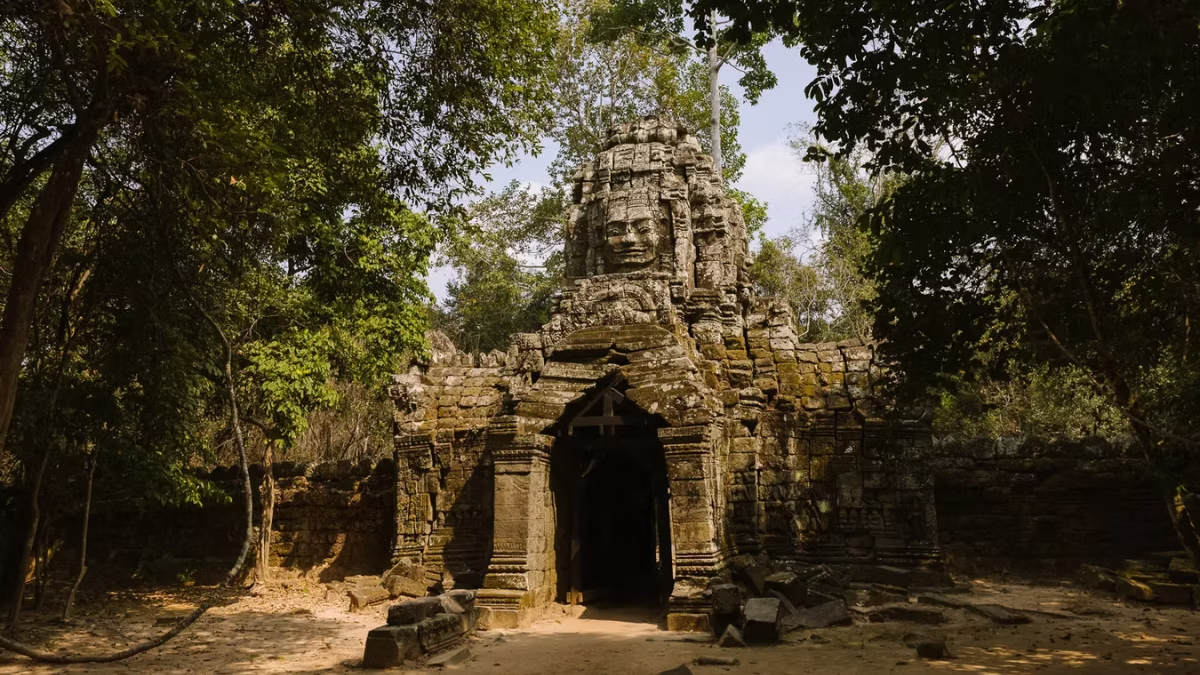
Bayon is the state temple of Jayavarman VII, built in the late 12th to early 13th century CE at the centre of Angkor Thom — the ancient walled capital. It is famous for its 54 towers carved with 216 giant smiling faces, believed to represent the Bodhisattva Avalokiteshvara (or possibly Jayavarman VII himself). Bayon also contains two levels of bas-reliefs — an outer gallery with historical scenes of military campaigns and daily Khmer life, and an inner gallery with mythological scenes. It opens at 7:30 AM and is included in the standard Angkor Pass.
If Angkor Wat is the most architecturally perfect temple at Angkor, Bayon is the most visually arresting. The 216 enormous stone faces — four to a tower, oriented to the four cardinal directions, each one smiling its inscrutable smile — create an experience unlike anything else in world architecture. Standing in the central sanctuary as the faces emerge from the stone around you, at every height and angle, is one of the genuinely unusual experiences in travel.
Top Tickets
Essential Facts
| Feature | Detail |
|---|---|
| Location | Centre of Angkor Thom, 1.7 km north of Angkor Wat |
| Built | Late 12th–early 13th century, under Jayavarman VII |
| Religion | Mahayana Buddhist |
| Opens | 7:30 AM |
| Closes | 6:30 PM |
| Entry | Included in Angkor Pass |
| Best time | Early morning (7:30–9:30 AM) for best light on the faces |
The History — Jayavarman VII’s Temple
Bayon was built by Jayavarman VII (reigned 1181–1218 CE), the most prolific builder in Angkor’s history. After decades of instability during which the Khmer capital was occupied by the Cham people of present-day Vietnam, Jayavarman reconquered and reunified the empire, rebuilt Angkor Thom, and created a building programme that produced more structures than any previous Khmer king.
Bayon represents a significant departure from Angkor Wat in both religion and architecture. Where Angkor Wat was built for Vishnu under Hindu cosmology, Bayon was built for Buddhism — specifically the Mahayana Buddhist tradition that Jayavarman favoured. The faces are widely believed to represent Avalokiteshvara, the Bodhisattva of Compassion in Mahayana Buddhism. Some scholars argue they also incorporate the features of Jayavarman VII himself — the divine king looking outward in all directions over his domain.
The 216 Faces — What You’re Looking At
Bayon’s 54 towers each carry four faces — one facing each cardinal direction — giving 216 faces in total (though some towers have been damaged and the count varies slightly). Each face is approximately 3 metres tall. They display a characteristic calm expression — eyes slightly lowered, lips curved in a gentle smile — that has been called the “Khmer smile.” The faces were originally painted in gold and were visible for many kilometres across the Angkor plain.
Why four faces per tower: The four cardinal directions — north, south, east, west — are a standard division of space in both Hindu and Buddhist cosmology. The faces looking outward in all directions represent the Bodhisattva’s omniscient compassion — watching over the entire kingdom simultaneously.
The expression: The faces are not identical — each has subtle differences in proportion and expression that suggest they were individually carved rather than mass-produced from a template. But they share the characteristic calm, slightly inward-looking expression that has been the subject of considerable scholarly and poetic attention. The French sculptor Rodin described it as the most beautiful smile he had ever seen; the writer Somerset Maugham wrote that it expressed “a knowledge of the things that cannot be known.”
Light on the faces: The faces catch light differently at different times of day. Morning (7:30–10:00 AM) provides warm sidelight that emphasises the three-dimensionality of the carving. The faces oriented to the east are best in morning light; those facing west are best in afternoon light.
The Bas-Reliefs at Bayon
Unlike Angkor Wat’s mythological bas-reliefs, Bayon’s outer gallery bas-reliefs are primarily historical and genre scenes — a portrait of 12th-century Khmer life in extraordinary detail.
The outer gallery (historical scenes): The most celebrated Bayon bas-reliefs depict military campaigns — specifically the naval battle on the Tonle Sap Lake between the Khmer and Cham forces. The Cham fleet is shown attacking the Khmer; crocodiles and fish are visible in the water below the boats. Daily life scenes accompany the military panels: markets, cockfights, fishing, cooking, children playing, and people going about ordinary activities of 12th-century Cambodia.
The daily life panels: These are among the most humanly engaging bas-reliefs in the entire Angkor complex. Unlike the mythological grandeur of Angkor Wat’s panels, the Bayon scenes show recognisable human activities — a woman nursing a baby, merchants weighing goods, people gambling at board games. They provide a vivid window into the everyday life of the Khmer capital at its height.
The inner gallery (mythological scenes): The inner gallery bas-reliefs are in poorer condition than the outer gallery but include scenes from Hindu mythology — indicating that the temple was modified after Jayavarman’s death as the empire returned to Hindu traditions.
Visiting Bayon — The Practical Experience
Ground level: The outer gallery bas-reliefs are explored at ground level. Move clockwise from the east entrance for the traditional reading order. Allow 30–45 minutes for a thorough walk of the outer gallery.
Upper terrace: From the outer gallery, stairs lead up to the upper terrace — the level where the face towers begin. This is where the experience becomes extraordinary. Walking between the face towers, with faces at every height looking down or across at you, is unlike any other environment in architecture.
The central sanctuary: The very centre of Bayon — the highest point of the upper terrace — is a circular sanctuary surrounded by the faces of the tallest towers. This is the sacred heart of the temple and an active place of Buddhist worship. Incense and flower offerings are typically present.
Best photography positions: Stand below a face and photograph upward (for the face + sky composition). Stand between two face towers and photograph the gap (for the corridor-between-faces composition). Stand at the outer edge of the upper terrace and photograph the face towers receding into depth.
The Relationship Between Bayon and Angkor Thom
Bayon sits at the geometric centre of Angkor Thom — the ancient walled city that Jayavarman VII built around it. Angkor Thom covers approximately 9 square kilometres, surrounded by an 8-metre-high wall and a 100-metre-wide moat. Its five gates are each approached by a causeway flanked by 54 gods and 54 demons holding the body of a nāga serpent — a composition that echoes the Churning of the Ocean of Milk at Angkor Wat.
For the full picture of what Angkor Thom contains beyond Bayon, see our Angkor Thom guide.
Frequently Asked Questions
How many faces does Bayon Temple have?
Bayon has 54 towers, each carved with four faces (one per cardinal direction), giving approximately 216 faces in total. Some towers have been partially damaged and the actual count varies slightly in scholarly literature.
Who is depicted in the faces of Bayon?
Most scholars believe the faces represent Avalokiteshvara — the Bodhisattva of Compassion in Mahayana Buddhism. Some scholars argue they also incorporate the features of King Jayavarman VII himself. The two interpretations are not mutually exclusive — Jayavarman may have identified himself with the Bodhisattva.
How does Bayon compare to Angkor Wat?
Angkor Wat is larger, older, and more architecturally coherent. Bayon is smaller but viscerally more unusual — the face towers create an experience that is unlike anything else in the world. Most visitors find Angkor Wat more impressive overall but Bayon more immediately striking.
When is the best time to visit Bayon?
Early morning (7:30–9:30 AM) provides the best light on the east-facing faces and is significantly less crowded than the midday period. The faces facing west are best in the late afternoon (3:30–5:30 PM).
