
Preah Khan Temple — The Complete Visitor Guide (2026)

Preah Khan (“Sacred Sword”) is a large, largely unrestored Buddhist temple complex built by Jayavarman VII in the late 12th century CE. Located on the Grand Circuit north of Angkor Thom, it covers approximately 56 hectares — making it the second-largest temple in the Angkor Archaeological Park after Angkor Wat. Its hallmarks are its long, atmospheric gallery corridors, the double-storey round-columned structure (unique in Angkor), and the enormous trees that grow through and over its walls. It opens at 7:30 AM, closes at 5:30 PM, and is included in the Angkor Pass.
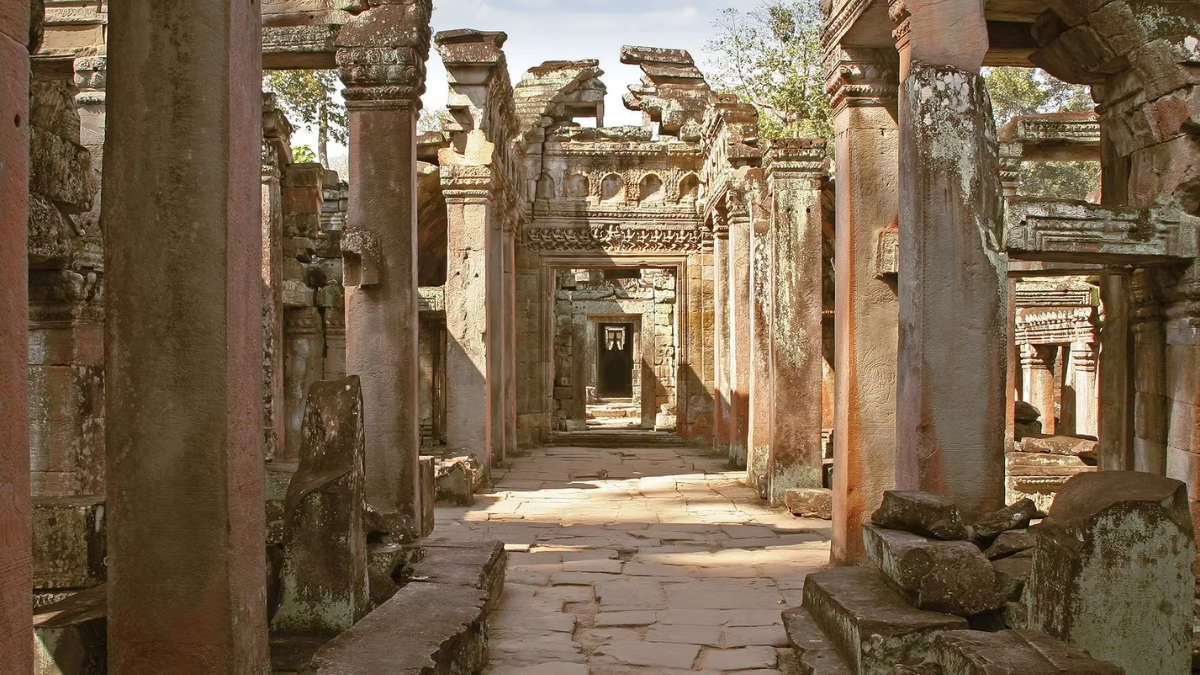
Preah Khan is the temple that serious Angkor visitors love best. It lacks the architectural perfection of Angkor Wat and the visual shock of Bayon, but it rewards slow exploration in a way that neither of those sites does. The long gallery corridors that run east-west and north-south through the complex create a navigational labyrinth that is disorienting in the best way — turn left at a doorway and find a chamber full of fallen stones; continue straight and emerge into a courtyard where a massive fig tree has cracked the western enclosure wall open; take a right and find the round-columned two-storey structure that has no parallel anywhere else in Angkor.
Top Tickets
Essential Facts
| Feature | Detail |
|---|---|
| Location | Grand Circuit, 1.5 km north of Angkor Thom North Gate |
| Built | Late 12th century, under Jayavarman VII |
| Original function | Buddhist monastery and temporary capital |
| Religion | Mahayana Buddhist |
| Opens | 7:30 AM |
| Closes | 5:30 PM |
| Entry | Included in Angkor Pass |
| Best time | Early morning (7:30–10:00 AM) |
The History — Jayavarman VII’s Temporary Capital
Preah Khan was built by Jayavarman VII as both a Buddhist monastery and his temporary capital while Angkor Thom was being constructed. The dedication stele — found in situ and now in the Angkor Conservation Workshop — records that the temple was dedicated to Jayavarman VII’s father, who was posthumously identified with the Bodhisattva Lokeshvara. It also records that the complex housed 97,840 people, required 5,324 villages to support it, and contained a Hall of Dancing Girls (apsara sanctuary) served by 1,000 female dancers.
As a working monastery of this scale, Preah Khan was essentially a self-contained city — with administrative buildings, libraries, hospitals (Jayavarman VII built a network of 102 hospitals across the empire), and residential halls for the enormous monastic community.
Key Features
The Main East-West Axis
The primary route through Preah Khan runs east-west — entering from the east gateway and proceeding through a series of increasingly sacred enclosures to the central sanctuary. This axis is approximately 800 metres long and takes you through four enclosures, each with its own gopura (entrance tower).
The eastern approach: The approach from the east gate is the most dramatic. A causeway flanked by stone garudas (mythological eagle-men) leads to the first enclosure wall. This is the recommended direction to begin your visit.
The long eastern gallery corridor: Inside the first enclosure, a long gallery corridor stretches north-south as far as you can see in both directions. The ceiling is largely collapsed, allowing filtered light to enter and trees to grow upward from the gallery floor. Walking this corridor north or south before heading west to the central sanctuary is one of the most atmospheric walks in the entire Angkor complex.
The Round-Columned Two-Storey Structure
The most architecturally unusual element of Preah Khan — and of the entire Angkor complex — is a two-storey structure near the central sanctuary area with round columns. Round columns are essentially unknown in Khmer architecture, which almost universally uses square or octagonal forms. This structure’s function remains debated: it has been called a library, a shrine, and a storeroom. Whatever its purpose, its distinctiveness makes it immediately memorable and easily recognisable.
The Trees
Like Ta Prohm, Preah Khan has been partially left to the jungle — but the specific tree compositions at Preah Khan are less managed and in some ways more dramatic. The silk-cotton trees and figs that grow through the outer enclosure walls of Preah Khan are less frequently photographed than Ta Prohm’s famous doorways but are often larger and more architecturally integrated.
The western enclosure wall trees: The most dramatic tree at Preah Khan is a massive Tetrameles that has cracked the western enclosure wall open over centuries of root growth. The wall has split into two segments, with the tree growing in the gap, its roots flowing into and through the stone in both directions.
The Hall of Dancers (Apsara Hall)
A large ceremonial hall north of the central sanctuary axis — the largest single space in Preah Khan — is identified by its inscription as the Hall of Dancers, where the temple’s 1,000 apsara dancers performed. The hall is roofless (the roof has collapsed) and the remaining stone walls are covered with apsara figures carved in relief — a density of decorative carving that gives some sense of what this space must have looked like at its height.
Walking Preah Khan — A Recommended Route
Enter from the east gate: Walk west along the main causeway (garudas on both sides), through the first enclosure gopura.
Turn south (left) into the long eastern gallery corridor: Walk this corridor south for 5–10 minutes, noting the light conditions, the trees growing through the ceiling gaps, and the collapsed sections. Return north and continue west.
Visit the Hall of Dancers (north of the central axis): Turn right (north) before the innermost enclosure gopura.
Reach the central sanctuary: The central sanctuary is a relatively small space — the innermost of the four concentric enclosures. A Buddha shrine is typically present.
Find the round-columned structure: It is north-west of the central sanctuary, accessible from the inner enclosure.
Exit through the western gopura: Walk west along the main axis to the western entrance and exit there — the western approach gives you the temple in reverse, with a different perspective on each element.
Total time: 1.5–2 hours for a thorough visit.
Frequently Asked Questions
Is Preah Khan worth visiting?
Yes — emphatically. Preah Khan is consistently rated by experienced Angkor visitors as one of the most rewarding temples on the circuit. Its scale, atmospheric quality, and low visitor numbers (relative to the main circuit sites) make it an outstanding choice for visitors with 2+ days at Angkor.
How crowded is Preah Khan?
Significantly less crowded than Angkor Wat, Bayon, or Ta Prohm. Early morning (7:30–9:00 AM) can be almost completely quiet. Even in peak season, Preah Khan never reaches the crowd levels of the headline sites.
How do I get to Preah Khan?
On the Grand Circuit, approximately 1.5 km north of Angkor Thom’s North Gate. By tuk-tuk from Angkor Thom it is 5 minutes; from Siem Reap it is approximately 25 minutes. It is typically visited on day two of an Angkor itinerary as part of the Grand Circuit.
Can I visit Preah Khan and Angkor Wat in the same day?
Yes — they are both within the Angkor Archaeological Park, 3.5 km apart. Most Small Circuit itineraries do not include Preah Khan (which is on the Grand Circuit). To visit both in a single day, you need a full-day itinerary starting at sunrise. See our itinerary guide for details.
