
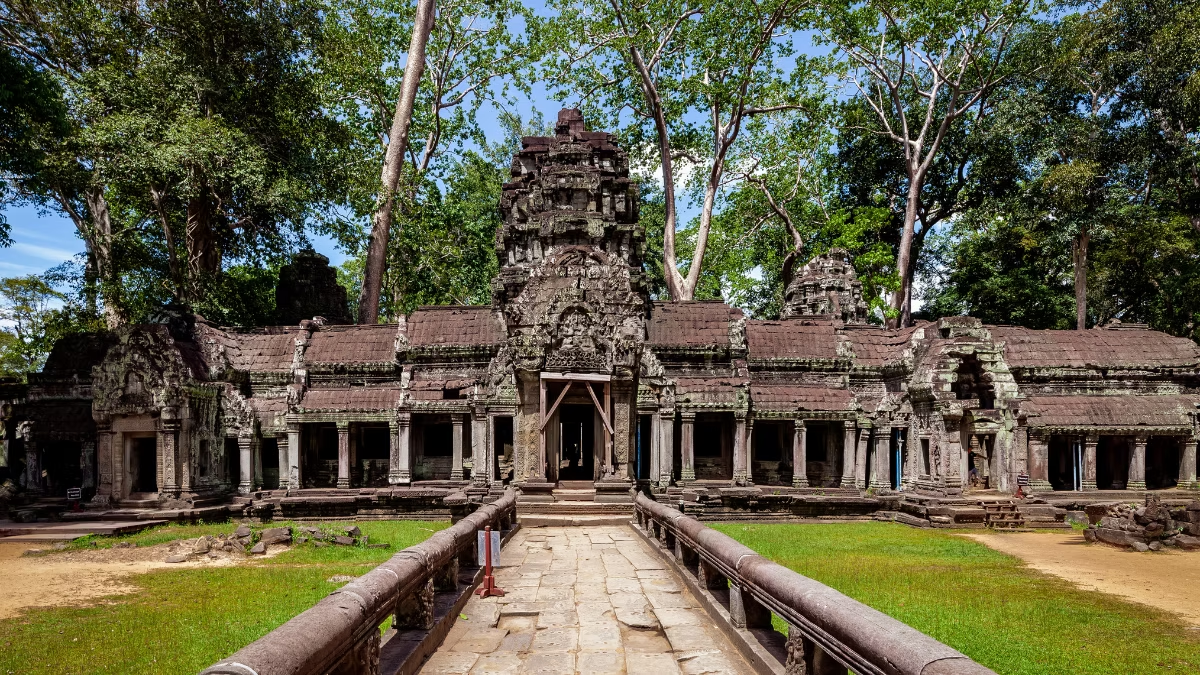
Ta Prohm — The Tomb Raider Temple Complete Guide (2026)

Ta Prohm is a 12th-century Buddhist monastery temple built by Jayavarman VII, located 1 km east of Angkor Thom and 3 km from Angkor Wat. It is famous for the massive Tetrameles and silk-cotton tree roots that have grown through and over its stone galleries — left deliberately in place by APSARA Authority as part of a conservation policy that maintains the relationship between the jungle and the ruin. It opens at 7:30 AM, closes at 5:30 PM, and is included in the Angkor Pass.
Ta Prohm is proof that ruin can be more moving than perfection. The trees that have split, engulfed, and restructured the stone galleries over eight centuries have created an architectural experience that no intentional design could replicate. The enormous roots that flow over doorways, spread across rooftops, and split ancient walls have transformed a 12th-century monastery into something that feels like a collaboration between human craft and natural force playing out across geological time.
Top Tickets
Essential Facts
| Feature | Detail |
|---|---|
| Location | 3 km east of Angkor Wat; 1 km south of Ta Keo |
| Built | Late 12th–early 13th century, under Jayavarman VII |
| Original name | Rajavihara (“Royal Monastery”) |
| Religion | Mahayana Buddhist |
| Opens | 7:30 AM |
| Closes | 5:30 PM |
| Entry | Included in Angkor Pass |
| Best time | Early morning (8:00–10:00 AM) or late afternoon (3:30–5:00 PM) |
The History — What Ta Prohm Was
Ta Prohm was originally called Rajavihara — the Royal Monastery. An inscription discovered in 1913 (and now housed in the Angkor Conservation Workshop) provides an extraordinary level of detail about the temple at its height: it housed 12,640 people, including 18 high priests, 2,740 officials, 2,232 assistants, and 615 dancers. The complex required 66,625 tonnes of rice per year to feed its inhabitants. Its treasures included gold dishes, pearls, Chinese silk, and 35 diamonds.
By the 15th century, with the collapse of Angkor as a political capital, the monastery was abandoned. For five centuries, the jungle reclaimed it. The French began recording it in the 19th century and partially cleared pathways for visitors in the early 20th century — but in a deliberate and significant decision, the major trees were left in place. Ta Prohm was to remain, as the conservators put it, “as it was found” — a monument to the relationship between human achievement and natural time.
The Trees — Species and Scale
The two tree species responsible for Ta Prohm’s famous appearance are:
Tetrameles nudiflora: A deciduous tree that can reach 30+ metres in height. Its buttress roots — the enormous fan-shaped root structures that spread horizontally from the base of the trunk — are the roots most commonly photographed at Ta Prohm. These flat, spreading roots flow over and through the stone walls in the compositions that appear on every postcard of the temple.
Ficus gibbosa (silk-cotton tree, or Bombax): A different growth pattern — the silk-cotton tree’s roots descend from above, like a waterfall of wood pouring over the stone gallery roofs and cascading to the ground. The most dramatic examples appear on the eastern enclosure walls.
Both species are rooted in the soil above the gallery roofs — they began as seeds deposited there by birds, grew into small plants, then progressively larger plants, and eventually into full trees whose roots descended through the walls as they grew. Some of the trees at Ta Prohm are estimated to be 300–400 years old.
The Most Famous Spots
The “Tomb Raider” doorway: The most photographed single composition at Ta Prohm is a doorway on the eastern gallery whose lintel is almost completely engulfed by the descending roots of a silk-cotton tree. A natural viewing platform has been created in front of this doorway. The 2001 film “Lara Croft: Tomb Raider” was partially filmed at Ta Prohm, and this doorway appears prominently — creating the “Tomb Raider temple” name that has stuck.
The eastern gallery roots: Walking east from the central sanctuary, the eastern gallery has some of the most dramatic root structures in the temple — enormous Tetrameles buttress roots flowing over entire gallery sections.
The fig tree over the library: Inside the western enclosure, a large fig tree has grown over and through one of the library structures. The combination of the carved stone library and the living tree draping it is one of the most affecting compositions in the temple.
The collapsed sections: Large portions of Ta Prohm have not been stabilised and remain as they were found — stone blocks scattered across the jungle floor, roots growing through the collapsed walls. The wooden boardwalks thread through these sections, giving you views of genuine archaeological complexity that the cleared areas of Angkor Wat cannot offer.
Conservation — Why the Trees Are Kept
The decision to maintain the trees at Ta Prohm is not purely aesthetic. The trees are a practical challenge: their roots are both what makes Ta Prohm visually extraordinary and what is slowly destroying its stone structure. The roots apply enormous and directional pressure to the stone — splitting walls, displacing keystones, and compromising structural integrity over time.
APSARA Authority and its conservation partners (including the Archaeological Survey of India, who have led conservation work here) have made selective decisions — removing trees whose root systems pose immediate structural danger while keeping those whose removal would cause more damage than their presence. Some trees have been removed; others have been carefully consolidated with the stone they grow through.
The boardwalks: Much of the visitation is now channelled through wooden boardwalks that keep visitors off the structurally fragile stone floors. Stay on the boardwalks — the stone underfoot in the open sections is genuinely fragile.
When to Visit — Crowds and Light
Ta Prohm is the second most visited temple on the Small Circuit after Angkor Wat and Bayon, and the most famous “Instagram moment” in the park. The iconic Tomb Raider doorway is rarely without a queue of visitors waiting for a clear shot in peak season.
Best visiting strategy:
- Arrive at 8:00–8:30 AM — before the midday tour bus surge
- Or arrive at 3:30–4:30 PM — when crowds have thinned significantly
- The jungle canopy provides good shade throughout the day, but midday (11:00 AM–2:00 PM) is densest with visitors
Light for photography: The jungle canopy creates dappled light that varies constantly. The most dramatic light enters from the east in the morning — the eastern gallery and Tomb Raider doorway are best photographed 8:00–11:00 AM.
Frequently Asked Questions
Why is Ta Prohm called the Tomb Raider temple?
The 2001 Angelina Jolie film “Lara Croft: Tomb Raider” was partially filmed at Ta Prohm. The distinctive doorway engulfed by tree roots appears in the film, and the name has been applied to the temple colloquially ever since.
Why haven’t the trees at Ta Prohm been removed?
APSARA Authority made a deliberate conservation decision to maintain Ta Prohm “as it was found” — preserving the relationship between the jungle and the ruin that makes it unique. The trees also present a practical challenge: in many cases, their removal would cause more structural damage than their presence.
How long should I spend at Ta Prohm?
A thorough visit with attention to the major tree compositions, the eastern gallery, and the boardwalk sections through the collapsed areas takes 1.5–2 hours. A highlights visit covering the main doorway and central sanctuary takes 45–60 minutes.
Is Ta Prohm better than Angkor Wat?
They are different experiences. Angkor Wat is an architectural masterpiece in excellent condition with extraordinary bas-reliefs. Ta Prohm is the most atmospheric of all the temples — wilder, more dramatic, and more emotionally affecting for many visitors. Most visitors rate both in their top three Angkor experiences.
