
Angkor Wat — Complete Visitor Guide (2026)

Angkor Wat is the world’s largest religious monument — a 12th-century Khmer temple complex covering 162 hectares in Siem Reap, Cambodia. It is open daily from 5:00 AM to 6:00 PM and requires an Angkor Pass ($37/1-day, $62/3-day, $72/7-day). Key highlights include the 800-metre bas-relief gallery, the five central towers (the tallest rising 65 metres), the iconic north reflecting pool at sunrise, and the inner sanctuary still used for active Buddhist worship. Allow 3–4 hours minimum for a thorough visit.
No description quite prepares you for Angkor Wat. You walk the 350-metre causeway, flanked by nāga serpent balustrades, toward five lotus-bud towers that grow progressively larger with every step — and by the time you reach the first enclosure, you understand instinctively why this place has held the imagination of travellers for five centuries. It is not simply large; it is designed to make you feel small in the presence of something cosmic.
This is the complete visitor guide to Angkor Wat itself — the main temple, its key features, and everything you need to plan a thorough and rewarding visit.
Top Tickets
Essential Facts
| Feature | Detail |
|---|---|
| Location | Angkor Archaeological Park, 5.5 km north of Siem Reap |
| Built | Early 12th century, c.1113–1150 CE |
| Builder | King Suryavarman II |
| Original religion | Hindu (Vishnu) — later converted to Buddhist |
| Opens | 5:00 AM (to allow sunrise visits) |
| Closes | 6:00 PM |
| Entry | Angkor Pass required ($37/1-day, $62/3-day, $72/7-day) |
| Children under 12 | Free (passport required) |
| Dress code | Shoulders and knees covered — enforced |
| Best time of day | Sunrise (5:00–7:00 AM) or late afternoon (3:30–5:45 PM) |
The Main Causeway and Reflecting Pools
The experience of Angkor Wat begins before you enter the temple. Walking east along the main western causeway — 350 metres of sandstone, flanked by seven-headed nāga serpent balustrades — is the defining arrival sequence in world architecture. The five towers rise progressively larger ahead of you; the moat (200 metres wide) reflects the sky on both sides.
The north reflecting pool (to your left as you walk east) is the most photographed spot in Cambodia. Before sunrise, the still water creates a perfect mirror image of the five towers silhouetted against the brightening sky. Arriving by 5:00–5:15 AM positions you for this composition.
The south reflecting pool is less crowded and offers the same composition from a slightly different angle.
For full detail on the sunrise experience, including timing by season and photography positioning, see our Angkor Wat Sunrise guide.
The Outer Gallery and Bas-Reliefs
The outer gallery of Angkor Wat contains approximately 800 metres of bas-relief carvings — the most extensive narrative carved stone gallery in the world. The reliefs depict scenes from Hindu mythology, Khmer military history, and cosmological narratives. Walking the full bas-relief circuit at a comfortable pace takes 45–60 minutes. The most celebrated panel — the Churning of the Ocean of Milk — is on the east gallery (south half) and shows gods and demons churning the cosmic sea to extract the elixir of immortality.
The outer gallery runs around the full perimeter of the first enclosure. Moving clockwise from the main western entrance:
West gallery (south half) — Battle of Kurukshetra: The climactic battle from the Hindu epic Mahabharata. Two opposing armies clash across a continuous 49-metre panel, identified by the arrows raining between them and the figures falling in the composition’s lower register.
South gallery (west half) — Army of Suryavarman II: The most historically significant panel — a processional portrait of the king and his military. Suryavarman II appears on a royal elephant, shaded by multiple parasols indicating his divine status. His generals and war elephants advance ahead of him.
South gallery (east half) — Heaven and Hell: 37 heavens and 32 hells, depicted in three horizontal bands. The top register shows the heavenly palaces; the middle shows the road to judgment; the lower depicts the torments of hell in graphic detail.
East gallery (south half) — Churning of the Ocean of Milk: The masterpiece of the entire gallery. 91 demons and 88 gods pull at the body of the serpent Vasuki, wound around Mount Mandara, churning the cosmic ocean for 1,000 years to extract amrita — the elixir of immortality. Vishnu presides at the centre. Apsaras rise from the churning water above.
East gallery (north half) — Victory of Vishnu over the Asuras
North gallery — Battle of Lanka: From the Ramayana — Rama’s battle against the demon king Ravana.
West gallery (north half) — Battle of the Gods and Asuras
For in-depth explanation of each panel with identification of key figures, see The Bas-Reliefs of Angkor Wat.
The Second Level
From the outer gallery, short staircases at the corner towers lead to the second level — a raised rectangular courtyard with four small ornamental ponds at its corners. This level is less visited than the ground floor and is worth taking time here. The upper towers become prominent, and the courtyard has a quieter, more contemplative atmosphere than the crowded gallery below.
The libraries: On both the north and south sides of the main axis, between the outer gallery and the inner sanctuary, stand pairs of rectangular “library” structures (their actual function remains debated). These make excellent foreground elements for photographs of the central towers.
The Third Level and Central Sanctuary
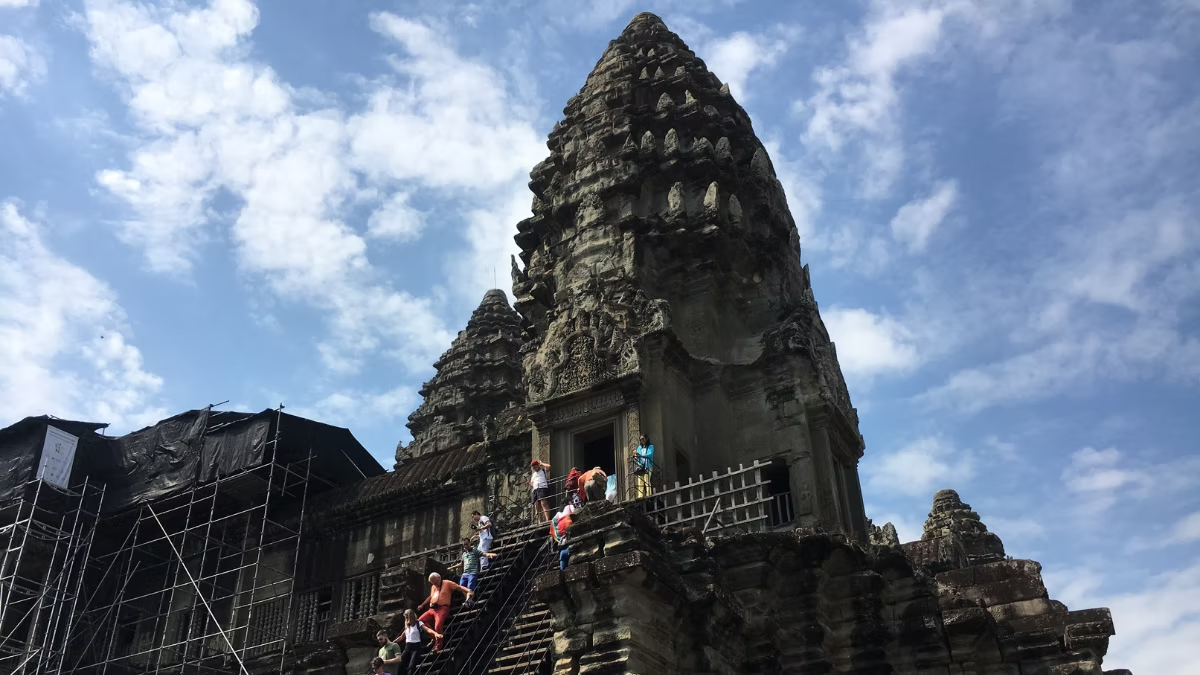
The third and highest level of Angkor Wat is reached by steep stone stairs — wooden stairs with handrails have been installed at one access point to make the ascent safer. The platform at the top supports the five central towers, with the highest rising 65 metres above the ground. Views from the upper gallery extend over the surrounding Angkor plain. The inner sanctuary contains active Buddhist shrines — remove shoes before entering.
The climb to the upper level is steep (45–55° angle). The installed wooden stairs with rope handrails at the north access point are the safest option. Allow 15–20 minutes to explore the upper gallery once you reach the top.
The five towers: The central tower is the tallest at 65 metres. The four corner towers are slightly shorter. Together they represent the five peaks of Mount Meru — the mythological centre of the Hindu cosmos. The towers are solid at their bases; the inner sanctuary is a small chamber within the central tower, not accessible through all four sides.
The inner sanctuary: An active place of Buddhist worship. Several Buddha statues, incense, and flower offerings are present. Remove shoes before entering. Maintain quiet and respect any ceremonies in progress.
Views from the upper gallery: The view over the Angkor plain from the third level — particularly looking west down the causeway and over the moat — is one of the most remarkable prospects in Southeast Asia. On a clear day, the jungle canopy extends to the horizon in every direction.
The Apsaras — 3,000 Individual Carvings
One of the most remarkable details of Angkor Wat is the approximately 3,000 apsara (celestial nymph) figures carved into the walls throughout the temple. Each one is subtly different from the next — different hairstyles, jewellery, postures, and expressions. Scholars have catalogued 37 distinct hairstyle variations. Look closely at the walls in the inner gallery corridors and you will see this individuality clearly.
Practical Visitor Information
Opening hours: 5:00 AM to 6:00 PM daily. The 5:00 AM opening is specifically to accommodate sunrise visits.
Entry: Angkor Pass required. Buy in advance online at ticket.angkorenterprise.gov.kh, at the ticket office on Apsara Road (opens 4:30 AM), or at Heritage Walk Mall kiosks. See our how to buy tickets guide.
Dress code: Shoulders and knees must be covered. Enforced at the entrance to the inner galleries. Sarongs available at the entrance for a small cost. See the full dress code guide.
Shoes: Remove before entering the inner sanctuary on the upper level.
Food and water: No food inside the galleries. Water vendors are present outside the main entrance. See our food guide.
Photography: Personal photography freely permitted throughout. Flash prohibited inside inner sanctuaries. Drone use requires an APSARA Authority permit. See our photography tips.
Crowds: Busiest from 9:00 AM–2:00 PM. Quietest in the late afternoon (3:30–5:45 PM) and immediately after sunrise. December and January are peak season.
Transport: Tuk-tuk from Siem Reap takes 15–20 minutes. See our getting there guide.
What Else to See in the Park
Angkor Wat is the centrepiece, but the Angkor Archaeological Park contains many other extraordinary temples:
- Bayon Temple — the temple of 216 giant smiling faces inside Angkor Thom
- Ta Prohm — the famous jungle temple where tree roots engulf the stone galleries
- Banteay Srei — the finest stone carvings in the Khmer world, in pink sandstone
- Preah Khan — a sprawling, atmospheric former capital temple
- Phnom Bakheng — the hilltop sunset viewpoint
For itinerary planning across all temples, see our 1-Day, 2-Day & 3-Day Itinerary guide.
Frequently Asked Questions
How long does it take to see Angkor Wat?
A minimum of 2 hours for a highlights-only visit; 3–4 hours for a thorough visit including all bas-relief panels, the second level, and the upper sanctuary. Budget 4+ hours if you plan to photograph extensively or attend sunrise at the reflecting pools.
What is the best time to visit Angkor Wat?
Sunrise (5:00–7:00 AM) for the reflecting pool experience and the most beautiful light. Late afternoon (3:30–5:45 PM) for the western façade in golden light and significantly fewer crowds. See our best time to visit guide.
Can you climb to the top of Angkor Wat?
Yes. The upper level (third tier) is accessible to visitors. The stairs are steep — wooden stairs with handrails have been installed at one access point to assist. Not recommended for those with severe vertigo or significant mobility limitations.
Is Angkor Wat still used for worship?
Yes. Angkor Wat is an active Buddhist temple with a resident monk community. Shrines, incense, and ceremonies are present throughout the inner sanctuary. Approach all active worship spaces with respect.
What does Angkor Wat mean?
“Angkor” derives from the Khmer word for “city” or “capital” (itself from the Sanskrit nagara). “Wat” is the Khmer word for “temple.” Angkor Wat therefore means approximately “City Temple” or “Temple of the Capital.”
