
Angkor Small Circuit vs Grand Circuit — Which Route Is Right for You?

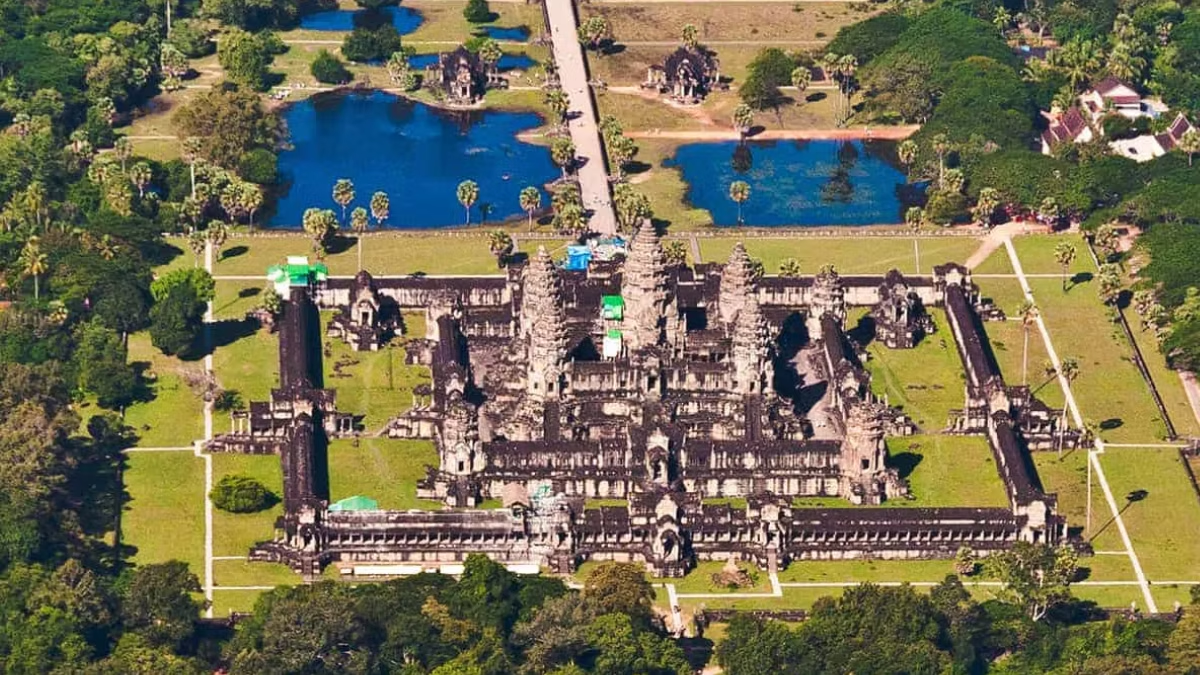
The Small Circuit (17 km) covers the most famous and most visited temples — Angkor Wat, Angkor Thom (including Bayon), Ta Prohm, and Banteay Kdei — and can be completed in a full day. The Grand Circuit (26 km) extends beyond the Small Circuit to include the quieter, less-restored outer temples including Preah Khan, Neak Pean, Ta Som, Eastern Mebon, and Pre Rup. Most first-time visitors do the Small Circuit on day one and the Grand Circuit on day two. If you only have one day, do the Small Circuit.
Two touring routes organise the Angkor Archaeological Park for visitors: the Small Circuit and the Grand Circuit. Both are roughly circular routes starting and ending in Siem Reap, covering different groups of temples at different distances from the park centre. Understanding the difference between them is one of the most useful pieces of planning knowledge you can have before arriving at Angkor.
Top Tickets
The Small Circuit at a Glance
The Small Circuit is a 17 km loop covering the most significant temples in the Angkor Archaeological Park — Angkor Wat, Angkor Thom (Bayon, Baphuon, the Terraces), Ta Prohm, Banteay Kdei, and Srah Srang. It is the recommended route for first-time visitors and those with only one day. The circuit requires a full day to complete thoroughly; a rushed version covering just the three main sites (Angkor Wat, Bayon, Ta Prohm) takes approximately 8–9 hours including transport, meals, and rest.
Temples on the Small Circuit:
- Angkor Wat — the main temple; the largest religious monument in the world
- Phnom Bakheng — the hilltop temple between Angkor Wat and Angkor Thom; best at sunset
- Angkor Thom South Gate — the monumental entrance to the ancient walled city
- Bayon — the temple of 216 giant smiling faces; inside Angkor Thom
- Baphuon — a pyramid temple undergoing restoration; the “chocolate cake” of Khmer architecture
- Phimeanakas — the royal palace temple
- Terrace of the Elephants — 350-metre royal viewing terrace
- Terrace of the Leper King — intricately carved royal terrace adjacent to the Elephants Terrace
- Ta Prohm — the famous jungle temple; tree roots engulf the stone galleries
- Banteay Kdei — a Buddhist monastery complex; less visited than Ta Prohm with similar atmosphere
- Srah Srang — the royal bathing pool; beautiful reflective lake, excellent at sunrise
Small Circuit statistics:
- Total circuit distance: approximately 17 km from Siem Reap and return
- Driving time only (tuk-tuk): approximately 1 hour 20 minutes total between temples
- Walking inside temples: 8–14 km depending on thoroughness
- Recommended time: 1 full day (7–8 hours active visiting)
The Grand Circuit at a Glance
The Grand Circuit is a 26 km loop that extends the Small Circuit to cover the outer temples of the Angkor Archaeological Park — Preah Khan, Neak Pean, Ta Som, Eastern Mebon, and Pre Rup. These temples are less visited, less restored, and in many cases more atmospheric than the crowded main circuit sites. The Grand Circuit is best done on a second day, after the Small Circuit, when you have the context and experience to appreciate the quieter, wilder temples.
Temples on the Grand Circuit:
- All temples on the Small Circuit (the routes overlap in the Angkor Thom area), plus:
- Preah Khan — a massive Buddhist temple complex; the temporary capital of Jayavarman VII
- Neak Pean — an island sanctuary in the centre of a large reservoir; unusual circular design
- Ta Som — a small temple; famous for a spectacular tree-engulfed eastern gateway
- Eastern Mebon — a pyramid temple on an artificial island (the reservoir is now dry)
- Pre Rup — a pyramid temple excellent for sunset views; much less crowded than Phnom Bakheng
Grand Circuit statistics:
- Total circuit distance: approximately 26 km from Siem Reap and return
- Recommended time: 1 full day
- Best approach: clockwise from Siem Reap, leaving Angkor Thom via the North Gate rather than the Victory Gate
Small Circuit vs Grand Circuit: Side-by-Side Comparison
| Feature | Small Circuit | Grand Circuit |
|---|---|---|
| Total distance | 17 km | 26 km |
| Time required | 1 full day | 1 full day |
| Crowd levels | High (main sites) | Low–Moderate |
| Temple condition | Well-restored | Partly restored / wilder |
| Best for | First-time visitors | Return visitors or history enthusiasts |
| Highlights | Angkor Wat, Bayon, Ta Prohm | Preah Khan, Neak Pean, Pre Rup |
| Sunset options | Phnom Bakheng | Pre Rup (quieter alternative) |
| Suitable for cyclists? | Yes (flat, paved roads) | Yes, but longer |
Which Circuit Should You Do First?
Do the Small Circuit first — always. The Small Circuit contains the three temples (Angkor Wat, Bayon, Ta Prohm) that define most visitors’ understanding of Angkor. The Grand Circuit temples are best appreciated after you have already absorbed the scale and style of the main circuit.
The exception is if you are a returning visitor, a serious archaeology enthusiast, or someone who specifically wants to avoid the large crowds concentrated at the main circuit sites. In these cases, starting with the Grand Circuit on day one is a valid and rewarding approach.
Can You Do Both Circuits in One Day?
Theoretically yes, but not recommended. Combining both circuits gives you approximately 26 km of driving and 10–15 km of walking, in addition to heat and sensory overload from processing multiple temples in a single day. The temples deserve time and attention — rushing through both circuits in a day means experiencing neither properly.
If you have only one day, do the Small Circuit thoroughly rather than both circuits superficially.
The Grand Circuit’s Hidden Gem: Pre Rup
One of the most underrated experiences in the Angkor Archaeological Park is watching sunset from Pre Rup — a pyramid temple on the Grand Circuit with elevated terraces and wide views over the surrounding jungle. Pre Rup closes at 7:00 PM, which allows a proper sunset experience. Unlike Phnom Bakheng, which has a strict 300-person capacity and requires arriving by 4:00 PM to guarantee entry, Pre Rup is rarely crowded at sunset. If Phnom Bakheng is your plan and you discover the queue is too long, Pre Rup is the best alternative.
Which Temples Can You Skip?
If time is pressing:
On the Small Circuit, you can skip:
- Phimeanakas and the Royal Enclosure — interesting ruins but less visually impressive than Bayon or the Terraces
- Baphuon — partially scaffolded for ongoing restoration; the exterior is visible but access inside is limited
On the Grand Circuit, you can skip:
- Eastern Mebon — a pyramid temple similar in concept to Pre Rup, but less dramatic; if time is short, Pre Rup is the more rewarding of the two
- Neak Pean — a relatively small temple; interesting concept (island sanctuary in a reservoir) but the viewing angle from the boardwalk is limited
Never skip:
- Angkor Wat
- Bayon
- Ta Prohm
- Preah Khan (Grand Circuit)
- Banteay Srei (requires a separate excursion north, not on either circuit, but worth it)
Frequently Asked Questions
What is the Small Circuit at Angkor?
The Small Circuit is a 17 km touring route covering the most important temples in the Angkor Archaeological Park — Angkor Wat, Bayon, Ta Prohm, Banteay Kdei, and others. It is the recommended route for first-time visitors and those with one day. A full day is needed to complete it properly.
What is the Grand Circuit at Angkor?
The Grand Circuit is a 26 km route extending beyond the Small Circuit to include the outer temples — Preah Khan, Neak Pean, Ta Som, Eastern Mebon, and Pre Rup. These are less crowded and less restored than the main circuit temples. Best done on a second day after the Small Circuit.
Can you do the Angkor circuits by bicycle?
Yes. Both circuits are suitable for cycling — the main roads are sealed and mostly flat. The Small Circuit (17 km) is manageable for most reasonably fit cyclists; the Grand Circuit (26 km) is longer and more tiring. Cycling is best in the cooler months (November to February).
How long does the Small Circuit take?
A full day — approximately 8–9 hours of active visiting including transport between temples, exploration inside each temple, and a midday lunch break. Starting at sunrise (5:00 AM at Angkor Wat) and finishing at Phnom Bakheng at sunset (around 6:30 PM) is the classic single-day Small Circuit.
Are both circuits covered by the Angkor Pass?
Yes. All temples on both the Small and Grand Circuits are included in the standard Angkor Pass ($37/1-day, $62/3-day, $72/7-day). The only sites near Angkor that require a separate ticket are Phnom Kulen ($20), Koh Ker ($15), and Beng Mealea (included in the Angkor Pass or $10 as a separate ticket).
