
What is Angkor Wat? History, Facts & Why You Must Visit

Angkor Wat is the world’s largest religious monument, a 12th-century Hindu-turned-Buddhist temple complex built by the Khmer Empire in present-day Siem Reap, Cambodia. Covering more than 400 acres and surrounded by a 200-metre-wide moat, it was constructed by King Suryavarman II between 1113 and 1150 CE and remains an active place of worship to this day. It is Cambodia’s most visited attraction and a UNESCO World Heritage Site.
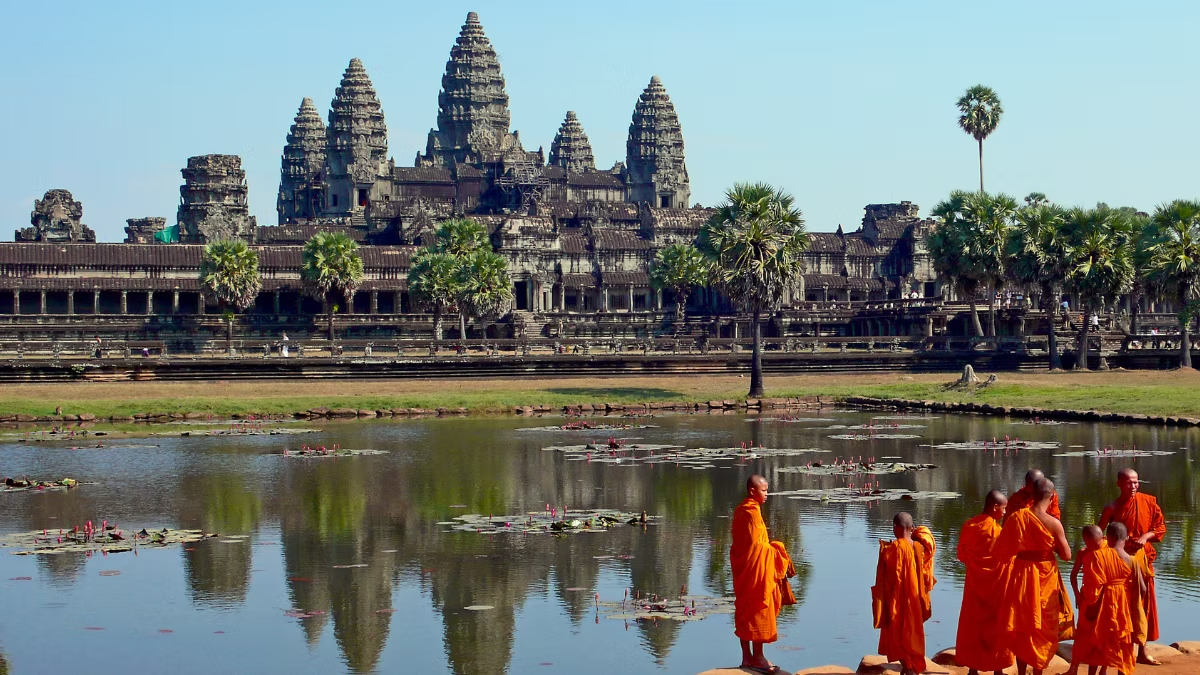
Angkor Wat is the kind of place that photographs simply cannot prepare you for. You round the corner of the main causeway, the five lotus-shaped towers rise out of the morning mist, and for a moment you forget to breathe. It is simultaneously a triumph of human engineering, a living religious site, a masterpiece of Khmer art, and the single most powerful reason to visit Cambodia.
Whether you are a first-time visitor trying to understand what you are about to see, a history enthusiast wanting the full backstory, or simply someone who has been told “you have to go” without much explanation, this guide covers everything you need to know before you set foot inside one of the most extraordinary sites on Earth.
Top Tickets
Where Exactly Is Angkor Wat?
Angkor Wat is located in Siem Reap Province in northwestern Cambodia, approximately 5.5 kilometres north of Siem Reap city centre. It sits within the Angkor Archaeological Park, a protected zone covering roughly 400 square kilometres that contains hundreds of ancient temples, hydraulic structures, and Khmer ruins from the 9th to 15th centuries.
Address: Krong Siem Reap, Cambodia. Get directions
Angkor Wat is the centrepiece of the Angkor Archaeological Park, a vast UNESCO World Heritage Site that encompasses the remains of the Khmer Empire’s successive capitals. The site is easily reached from Siem Reap — the nearest city and the base for all visits — by tuk-tuk, bicycle, private car, or guided tour.
The Angkor Archaeological Park itself contains dozens of significant temple complexes beyond Angkor Wat, including Bayon Temple, Ta Prohm, and Preah Khan, all accessible with a single Angkor Pass.
Who Built Angkor Wat and When?
Angkor Wat was built by King Suryavarman II of the Khmer Empire between approximately 1113 and 1150 CE. It was originally constructed as a Hindu temple dedicated to the god Vishnu and designed to serve as the king’s state temple and eventual mausoleum. Over the following centuries, as the Khmer Empire transitioned from Hinduism to Theravada Buddhism, Angkor Wat was gradually converted into a Buddhist temple — a function it continues to serve today.
The construction of Angkor Wat was a project of staggering ambition. Historians estimate that it required the labour of thousands of workers, including stone carvers, architects, engineers, and sculptors, working over decades to complete. The sandstone blocks used in its construction were quarried at Phnom Kulen mountain, roughly 40 kilometres to the northeast, and transported via a network of canals to the building site.
The name “Angkor Wat” translates loosely from Khmer as “City Temple” — angkor meaning “city” or “capital” and wat meaning “temple.” It was the largest temple in the Khmer Empire at the time of its construction and remains the largest religious monument in the world today.
What Does Angkor Wat Look Like? Architecture & Design
Angkor Wat is designed as a symbolic representation of Mount Meru, the mythical home of the Hindu gods. It consists of three rectangular galleries rising to a central tower, flanked by four smaller towers — the five towers together representing the five peaks of Mount Meru. The entire complex is enclosed by a 200-metre-wide moat, which symbolises the cosmic ocean surrounding the mountain. The main temple measures 1,025 metres by 800 metres at its outer wall.
The architectural language of Angkor Wat is immediately recognisable: the five lotus-bud towers, the long axial causeway lined with nagas (serpent deities), the elaborate sandstone bas-reliefs stretching nearly 800 metres around the third gallery, and the intricate carvings of apsaras (celestial nymphs) decorating every surface.
The temple faces west — unusual for Khmer temples, which typically face east — which many scholars interpret as an association with the setting sun and, therefore, with death, reinforcing its role as a funerary monument for King Suryavarman II.
The bas-reliefs are among the greatest artistic achievements in Southeast Asian history. They depict scenes from the Hindu epics Mahabharata and Ramayana, the Churning of the Ocean of Milk (one of Hinduism’s most important creation myths), battles of the Khmer army, and the heavens and hells of Hindu cosmology. Walking the full gallery of bas-reliefs at a relaxed pace takes between 45 minutes and an hour. Our dedicated bas-reliefs guide covers each panel in detail.
The Khmer Empire: The Civilisation Behind Angkor Wat
The Khmer Empire was one of the most powerful and sophisticated civilisations in Southeast Asian history. At its peak, between the 9th and 13th centuries CE, it controlled a vast territory encompassing much of present-day Cambodia, Thailand, Laos, and southern Vietnam. The Angkor region served as the empire’s capital from approximately 802 CE, when King Jayavarman II declared himself a god-king (devaraja), until the mid-15th century when the capital was eventually abandoned and moved to Phnom Penh.
The Khmer kings were prolific builders. Over the course of several centuries, they constructed a dense network of temples, reservoirs (barays), canals, and roads across the Angkor plain, creating what was, in its time, one of the largest pre-industrial urban complexes in the world. Angkor Wat represents the pinnacle of this building tradition.
To understand the full sweep of Khmer history and how it shaped the temples you will see, read our in-depth Khmer Empire history guide.
What Happened to Angkor Wat? Abandonment and Rediscovery
Despite the collapse of Angkor as a political capital in the 15th century, Angkor Wat itself was never truly abandoned. Buddhist monks continued to inhabit and maintain the temple, protecting it from the jungle that swallowed many neighbouring sites. Portuguese missionaries encountered it in the 16th century, and it appeared in European traveller accounts with increasing frequency from the 17th century onwards.
The temple entered international consciousness in the 19th century when French explorer Henri Mouhot published widely read accounts of his travels in Cambodia, describing Angkor Wat in terms that captured the European imagination. Large-scale archaeological study and restoration work began under the French colonial administration in the late 19th century and has continued, with some interruptions, to the present day.
Today, Angkor Wat is managed by APSARA Authority (Authority for the Protection and Management of Angkor and the Region of Siem Reap), a Cambodian government body responsible for conservation, research, and tourism management across the archaeological park.
Is Angkor Wat Still an Active Religious Site?
Yes. Despite its status as a major tourist attraction receiving over a million visitors annually, Angkor Wat remains a functioning Buddhist temple. A community of monks lives and worships within the complex. Visitors will often see monks in saffron robes conducting ceremonies, meditating, or simply going about their daily lives. Buddhist shrines, incense, and offering flowers are present throughout the inner sanctuary.
This dual identity — ancient monument and living temple — is part of what makes Angkor Wat so affecting. You are not visiting a museum reproduction. You are entering a place of genuine spiritual significance to the Cambodian people, a fact that shapes the dress code requirements and etiquette expected of all visitors.
Why Is Angkor Wat So Famous?
Several factors have combined to make Angkor Wat one of the most visited and recognised monuments in the world:
Scale. It is the largest religious monument ever constructed by human beings — a fact that does not fully register until you are standing at its base looking up at towers that rise 65 metres above the ground.
Preservation. Unlike many ancient sites of comparable age, Angkor Wat is extraordinarily well preserved. Centuries of continuous habitation by monks, combined with a geography that kept it above the jungle canopy, spared it from the fate that befell many neighbouring temples.
Artistry. The quality and quantity of the decorative carving at Angkor Wat is unmatched in the ancient world. Approximately 3,000 apsara figures are carved into the temple’s walls, each one subtly different from the next.
Spirituality. The temple was designed with extraordinary cosmological precision. Its proportions encode the cycles of Hindu time, its orientation tracks the movement of the sun across the seasons, and its design maps the geography of the Hindu universe.
Accessibility. Unlike many comparably impressive ancient monuments, Angkor Wat is relatively straightforward to visit and is served by a well-developed tourist infrastructure in nearby Siem Reap.
What Else Is There to See at Angkor?
Angkor Wat is the star, but the Angkor Archaeological Park contains dozens of other remarkable temples. The most essential are:
- Bayon Temple — the temple of the giant smiling faces, inside the ancient city of Angkor Thom
- Ta Prohm — the famous “Tomb Raider temple,” where massive tree roots engulf the stone galleries
- Banteay Srei — a smaller temple celebrated for its exquisite pink sandstone carvings
- Preah Khan — a sprawling, largely unrestored temple that rewards careful exploration
- Phnom Bakheng — the hilltop temple that offers the most celebrated sunset view over the Angkor plain
Planning how to fit all of these into your visit is one of the key challenges of an Angkor trip. Our Angkor Wat itinerary guide walks you through the best routes for 1-day, 2-day, and 3-day visits.
Planning Your Visit
Angkor Wat is open to visitors every day of the year from 5:00 AM to 6:00 PM. The Angkor Archaeological Park requires an Angkor Pass, available as a 1-day ($37), 3-day ($62), or 7-day ($72) ticket. Children under 12 enter free. Tickets can be purchased online, at the ticket office on Apsara Road (4 km from Siem Reap centre), or at self-service kiosks at Heritage Walk Mall in Siem Reap.
For complete visitor logistics, see:
- Angkor Wat opening hours
- How to get to Angkor Wat from Siem Reap
- Best time to visit Angkor Wat
- Angkor Pass — 1-Day, 3-Day & 7-Day explained
Frequently Asked Questions
What is Angkor Wat?
Angkor Wat is the world’s largest religious monument, a 12th-century temple complex built by the Khmer Empire in Siem Reap, Cambodia. Originally a Hindu temple dedicated to Vishnu, it later became Buddhist and remains an active place of worship. Covering more than 400 acres and surrounded by a 200-metre moat, it is Cambodia’s most iconic landmark and a UNESCO World Heritage Site.
Who built Angkor Wat?
Angkor Wat was built by King Suryavarman II of the Khmer Empire, who reigned from approximately 1113 to 1150 CE. Construction took several decades and required thousands of labourers, stone carvers, and architects. The sandstone used in its construction was quarried at Phnom Kulen mountain, about 40 kilometres away, and transported to the site by canal.
When was Angkor Wat built?
Angkor Wat was constructed between approximately 1113 and 1150 CE, during the reign of King Suryavarman II. It is therefore around 900 years old. Despite its age, much of the temple remains remarkably well preserved, thanks in part to centuries of continuous care by Buddhist monks.
Is Angkor Wat Hindu or Buddhist?
Angkor Wat began as a Hindu temple dedicated to Vishnu and was built according to Hindu cosmological principles. Over the following centuries, as the Khmer Empire converted to Theravada Buddhism, the temple was gradually adapted for Buddhist worship. Today it functions as a Buddhist temple, and a community of monks lives and worships on the grounds.
Why does Angkor Wat face west?
Most Khmer temples face east, towards the rising sun. Angkor Wat is one of the few that faces west. Many scholars believe this is because it was designed as a funerary monument for King Suryavarman II — the setting sun being associated with death in Hindu cosmology. Others argue it was to align the temple with the setting sun during the spring equinox, when an astronomical spectacle occurs over the central tower.
Is Angkor Wat the largest temple in the world?
Yes. Angkor Wat is the largest religious monument ever constructed. The temple complex covers approximately 162 hectares (400 acres) within its outer enclosure wall, and the broader Angkor Archaeological Park — which contains hundreds of related structures — covers around 400 square kilometres. No other single religious complex built anywhere in the world at any time in history surpasses it in total area.
Do you need a ticket to visit Angkor Wat?
Yes. Entry to Angkor Wat and all temples within the Angkor Archaeological Park requires an Angkor Pass, purchased from Angkor Enterprise. Tickets are available as 1-day ($37), 3-day ($62), or 7-day ($72) passes. The pass is non-transferable, includes your photograph, and is checked at the entrance to each major temple. Children under 12 enter free.
Can you visit Angkor Wat independently, without a guide?
Yes. Angkor Wat is open to independent visitors and is navigable without a guide. However, many visitors find that a knowledgeable guide transforms the experience — the bas-reliefs, the cosmological symbolism, and the historical context are vastly richer when explained by an expert. Private and small-group guided tours are available from Siem Reap for half-day, full-day, and multi-day itineraries.
Is Angkor Wat worth visiting?
Angkor Wat is consistently ranked among the top travel experiences in the world, and the overwhelming consensus among visitors is that it surpasses expectations. The combination of architectural scale, artistic achievement, historical depth, and spiritual atmosphere is unmatched anywhere on Earth. If you are anywhere near Southeast Asia, it is emphatically worth the detour.
How long does it take to visit Angkor Wat?
The main Angkor Wat temple alone requires a minimum of 2–3 hours to explore at a reasonable pace. To see the highlights — including the outer galleries, the bas-reliefs, the inner sanctuary, and the central towers — allow 3–4 hours. A full day allows for a more thorough visit including the reflecting pools and the surrounding grounds.
