
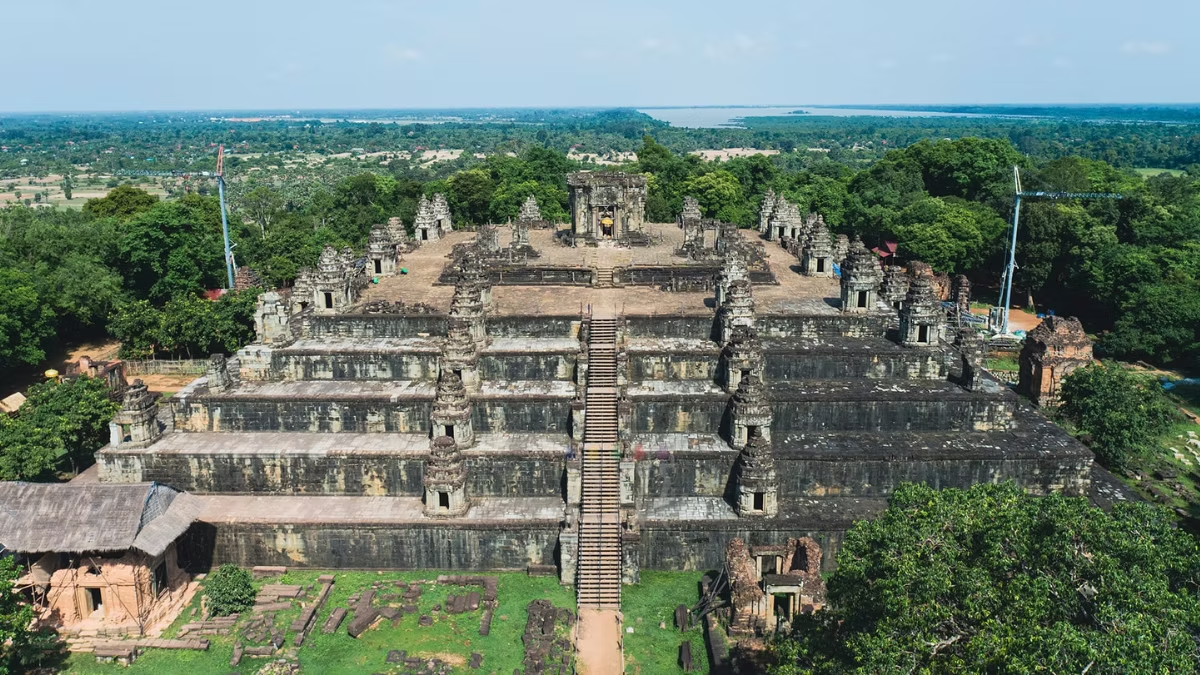
Phnom Bakheng — Angkor’s Best Sunset Temple (Complete Guide)

Phnom Bakheng is a hilltop Hindu temple built in the late 9th century CE, located 1.3 km north of Angkor Wat. It sits on a natural hill 65 metres above the Angkor plain and offers the most celebrated sunset viewpoint in the archaeological park — a panoramic view over the surrounding jungle, with Angkor Wat’s five towers visible in the distance. The summit has a strict capacity limit of 300 visitors. Arrive at the base of the hill by 4:00 PM at the latest in peak season to guarantee entry. Phnom Bakheng is included in the Angkor Pass.
Phnom Bakheng is where you go to see Angkor Wat from the outside. After spending hours inside the temple — walking the galleries, climbing the towers, examining the bas-reliefs — stepping onto the summit of Phnom Bakheng and seeing Angkor Wat’s silhouette on the horizon, surrounded by 100 km² of jungle, gives you the perspective that transforms a great monument into a comprehensible landscape.
Top Tickets
Essential Facts
| Feature | Detail |
|---|---|
| Location | 1.3 km north of Angkor Wat, south of Angkor Thom South Gate |
| Built | Late 9th century (c.889 CE) by King Yasovarman I |
| Religion | Hindu (dedicated to Shiva) |
| Hill height | 65 metres above the Angkor plain |
| Opens | 7:30 AM |
| Closes | 7:00 PM (latest closing time in the park) |
| Capacity limit | 300 visitors on the summit at any time |
| Entry | Included in Angkor Pass |
History — The First Angkor Capital Temple
Phnom Bakheng predates Angkor Wat by more than 200 years. It was built by King Yasovarman I (reigned 889–910 CE), who moved the Khmer capital to Angkor and chose Phnom Bakheng — the only significant natural hill in the area — as the site of his state temple. The temple was conceived as the symbolic centre of his new capital, Yasodharapura.
Architecturally, Phnom Bakheng is a temple mountain — a pyramid of five tiers topped with five towers in quincunx, the same basic arrangement that Angkor Wat would refine to perfection two centuries later. It originally carried 108 towers arranged across its five tiers and surrounding terraces — 108 being a sacred number in both Hinduism and Buddhism, appearing repeatedly in Khmer religious architecture.
Many of these towers have collapsed. The central sanctuary remains, along with the five topmost towers, and the dramatic hilltop setting that no subsequent Khmer king could replicate because no subsequent site had a natural hill to build on.
The Sunset View — What You See
From the Phnom Bakheng summit, the view extends 360° over the Angkor Archaeological Park and the surrounding Siem Reap province.
Angkor Wat (south-southwest): The five towers of Angkor Wat are visible approximately 1.5 km to the south-southwest. In the late afternoon, as the sun descends to the west-southwest, Angkor Wat’s towers are silhouetted against the sky or glowing gold depending on cloud conditions. This is the view that has made Phnom Bakheng famous — the most distant and therefore most contextualising view of Angkor Wat available from within the archaeological park.
The jungle canopy: The surrounding view is almost entirely jungle — the Angkor plain was extensively forested as the urban areas of the ancient city were abandoned, and what you see now is several hundred years of regrowth over the former urban landscape of the Khmer capital. Occasional temple roofs protrude above the canopy.
The Tonle Sap Lake (wet season): In the wet season (August–October), when the lake expands to its maximum size, Tonle Sap is sometimes visible on the horizon to the south — a remarkable silver sheen above the tree canopy on clear days.
Sunset timing: The sun sets to the west-northwest in summer and west-southwest in winter. At no time of year does it set directly behind Angkor Wat’s towers — the towers are too far south of the sun’s setting point for this alignment. But the towers are illuminated by the setting sun’s light in the late afternoon, which gives them the amber-gold glow that is the basis of the famous view.
The 300-Person Capacity Limit — How It Works
APSARA Authority enforces a strict limit of 300 visitors on Phnom Bakheng’s summit at any given time. During peak season (December and January), the summit fills by approximately 4:30–5:00 PM, and visitors arriving after this point are turned away at the top of the hill (not at the base). The only reliable way to guarantee summit access at sunset in peak season is to arrive at the base of the hill by 4:00 PM.
The capacity limit was introduced after structural concerns about the temple’s stability under heavy visitor loads. It is enforced by APSARA Authority staff at the top of the access path — once 300 people are counted on the summit, no further visitors are admitted until someone leaves.
What happens if you arrive late: You may be allowed to climb the hill to the temple level (the terraces around the base of the pyramid) but not onto the summit itself. The view from the terrace level is still good but not the full panoramic sunset experience.
Peak season (December–January): Arrive at the hill base by 3:30–4:00 PM. The climb takes 20–25 minutes.
Shoulder season (February–March, October–November): Arrive by 4:30 PM.
Low season (April–September): 5:00 PM is usually sufficient, but earlier is always better.
The Climb — What to Expect
Phnom Bakheng is accessed by a path on the south side of the hill, approximately 400 metres long with a gradual incline. The final approach steepens. The walk takes approximately 20–25 minutes at a moderate pace.
Elephant rides: Until 2020, elephant rides up the hill were offered. These were discontinued. The climb is on foot only.
Surface: The path is packed earth with some stone sections. In the wet season it can be slippery — wear shoes with grip.
At the top: The temple pyramid rises several tiers above the hill summit. The main access points to the upper sanctuary are on the east and west faces. The views are best from the south face (looking toward Angkor Wat) and the west face (looking into the setting sun).
Morning Visit — A Better-Kept Secret
Almost everyone visits Phnom Bakheng at sunset. Very few visit it in the morning — and the morning experience is in some ways superior.
No capacity pressure: The 300-person limit exists but is almost never approached in the morning. You can arrive at your own time and climb at your own pace.
Better light on the temple itself: Morning light from the east illuminates the temple’s eastern faces beautifully. The carved surfaces of the remaining towers are well-lit for close-up examination.
Quieter: On a weekday morning between 8:00 and 10:00 AM, Phnom Bakheng is one of the quietest temples in the Angkor complex.
The view to the east: The morning visit gives you a view toward the east — toward Angkor Thom’s North Gate, the Baray (reservoir) beyond, and the jungle canopy stretching to the horizon. A completely different perspective from the sunset view.
Frequently Asked Questions
Why is Phnom Bakheng famous?
For its sunset panoramic view over the Angkor Archaeological Park, with Angkor Wat’s five towers visible in the distance as the sun descends. It is the highest point accessible to visitors in the park and the only spot that gives a contextualising overview of Angkor Wat within its landscape.
How many people are allowed on Phnom Bakheng at sunset?
300 visitors on the summit at any one time. This limit is strictly enforced by APSARA Authority staff. Visitors who arrive after the limit is reached are turned away at the summit access point.
What time should I arrive at Phnom Bakheng for sunset?
At the hill base by 4:00 PM in peak season (December–January); 4:30 PM in shoulder season; 5:00 PM in low season. The climb takes 20–25 minutes. Arriving earlier guarantees a good position on the summit.
Is Phnom Bakheng included in the Angkor Pass?
Yes. Phnom Bakheng is included in the standard Angkor Pass (all tiers). No separate entry fee is required.
Is the sunset view from Phnom Bakheng worth the effort?
Yes — on a clear or partly cloudy afternoon, the view of Angkor Wat’s towers catching the last light of the day over the jungle canopy is one of the defining Angkor experiences. On a completely overcast afternoon, the view is less dramatic but the atmospheric value of the hilltop setting is still considerable.
