
The Bas-Reliefs of Angkor Wat — A Complete Visual Guide

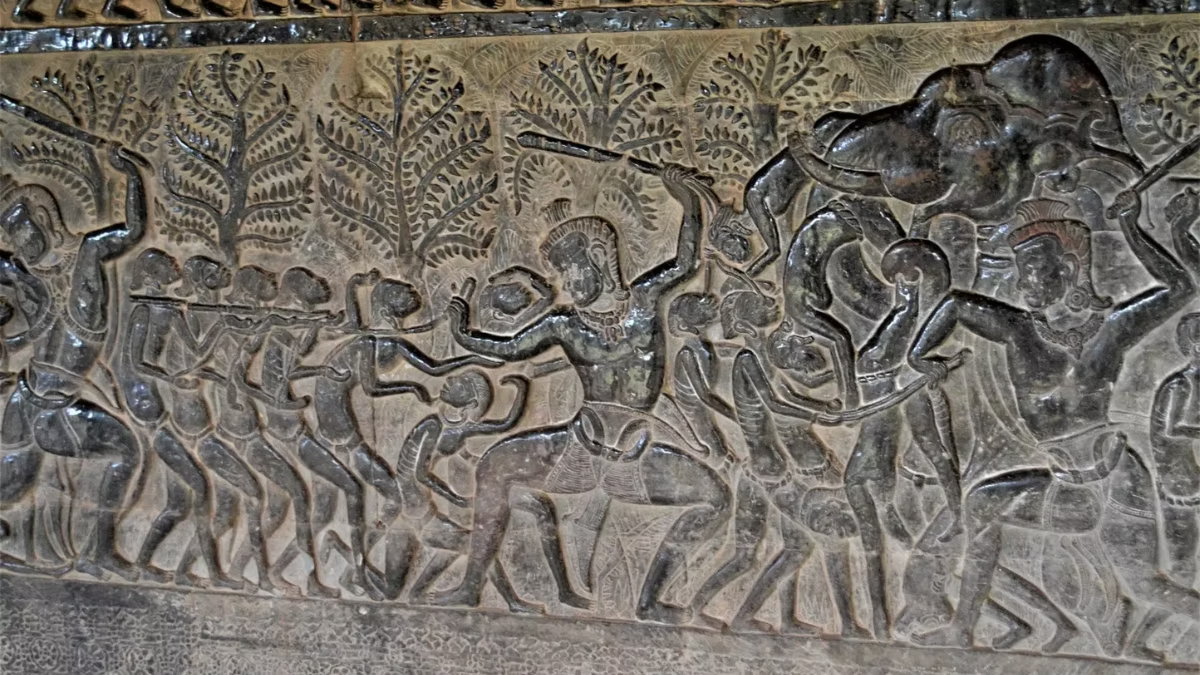
The bas-reliefs of Angkor Wat line the outer gallery of the first enclosure in a continuous band approximately 800 metres long and 2 metres high. They depict eight major scenes from Hindu mythology and Khmer history, including the Battle of Kurukshetra, the Army of Suryavarman II, the Churning of the Ocean of Milk, and Heaven and Hell. Walking the full circuit takes 45–60 minutes. The best light for viewing and photographing the reliefs is morning (7:30–10:00 AM) or late afternoon (3:00–5:00 PM), when raking sidelight emphasises the depth of the carving.
The bas-reliefs of Angkor Wat are not decoration. They are a library — a 12th-century visual encyclopaedia of Hindu cosmology, Khmer military history, and the mythology that shaped the civilisation that built them. Every figure, every battle scene, every tortured soul in the Hell panel has a specific identity and a specific narrative context. Walking the gallery without understanding what you are looking at is like walking through a library without being able to read.
This guide gives you everything you need to read it.
Top Tickets
The Layout — How to Navigate the Gallery
The bas-relief gallery runs along the inside of the outer enclosure wall, accessible from the main western entrance. Moving clockwise from the main entrance gives you the traditional reading order used by most guides:
- West gallery (south half) — Battle of Kurukshetra
- South gallery (west half) — Army of Suryavarman II
- South gallery (east half) — Heaven and Hell
- East gallery (south half) — Churning of the Ocean of Milk (the highlight)
- East gallery (north half) — Victory of Vishnu over the Asuras
- North gallery — Battle of Lanka
- West gallery (north half) — Battle of the Gods and Asuras
The most important panels are the Churning of the Ocean of Milk (east gallery, south half) and the Army of Suryavarman II (south gallery, west half). If time is limited, prioritise these two.
Panel 1: The Battle of Kurukshetra (West Gallery, South Half)
The Battle of Kurukshetra depicts the climactic battle from the Hindu epic Mahabharata — the conflict between the Pandavas and the Kauravas at the field of Kurukshetra. This 49-metre panel shows two armies colliding in a continuous melee of infantry, cavalry, war elephants, and archers. The Kauravas advance from the left; the Pandavas from the right. Key identifiable figures include Bhishma, pierced by arrows, and Krishna serving as charioteer to Arjuna. The dead and dying fill the lower register.
How to identify the two sides: The Kauravas (advancing from the left) have their banners moving to the right. The Pandavas (from the right) advance to the left. The two armies meet in the centre in a tangle of weapons and bodies.
The dead in the lower register: The lower band of the panel is occupied by the fallen — soldiers, horses, and elephants lying where they died. This compositional choice, with the living in the upper register and the dead below, is one of the technical achievements of the carving.
Bhishma: On the Kaurava side, one figure is shown pierced by multiple arrows — this is the great warrior Bhishma, who cannot die until he chooses to. He lies on a bed of arrows.
Panel 2: The Army of Suryavarman II (South Gallery, West Half)
This is the most historically significant of the bas-relief panels — not mythology but history. It shows the military procession of King Suryavarman II himself, depicted twice in the panel (once on a royal elephant, once seated on a throne receiving tribute). The king is identified by the multiple parasols above him — the number of parasols indicated royal rank in the Khmer world. His generals, bodyguards, ministers, and allied forces march behind him. A contingent of Thai (Syam Kuk) mercenary soldiers is identified by inscription.
Suryavarman II on his elephant: The most important figure in the panel. He sits on a royal elephant shaded by 15 parasols — more than any other figure in the panel. His mahout (elephant driver) kneels before him. His officials and ministers march alongside.
The Syam Kuk soldiers: A group of marching soldiers identified by inscription as “Syam Kuk” — Thai mercenaries or allied soldiers — march in a notably different style from the Khmer troops, wearing different helmets and carrying different weapons. This is one of the earliest known representations of Thai people in Cambodian art.
The generals in palanquins: The military commanders travel in covered palanquins (litters), carried by soldiers. Their rank is indicated by the number of parasols above them.
Panel 3: Heaven and Hell (South Gallery, East Half)
The Heaven and Hell panel depicts the Hindu afterlife — 37 heavens above and 32 hells below, separated by the road of the dead in the middle register. Yama, the God of Death, presides over the judgment. His assistants Dharma and Chitragupta weigh the souls of the dead. The righteous proceed upward to the celestial palaces; the wicked are escorted downward into depicted torments.
The three registers: The composition is divided horizontally into three bands. The top register shows the heavenly palaces of the righteous — figures in architectural frames enjoying the pleasures of paradise. The middle register shows the road of the dead, with Yama on his buffalo presiding at the centre. The lower register shows the hell torments — figures being sawn in half, boiled, impaled, and subjected to various specific punishments corresponding to specific sins.
Yama: The God of Death sits on his buffalo at the centre of the composition, flanked by his two assessors. He is large — much larger than the figures around him — indicating divine status.
The 32 hells: Each hell is specific. According to the accompanying text, different sins lead to different hells: adulterers are raked; the cruel are boiled; thieves are pierced. The Khmer carved these with evident relish and specific knowledge of the Buddhist-Hindu hybrid afterlife tradition they inherited.
Panel 4: Churning of the Ocean of Milk (East Gallery, South Half)
The Churning of the Ocean of Milk is the masterpiece of the entire bas-relief gallery and one of the greatest achievements of Khmer art. It depicts the Hindu creation myth of Samudra Manthana: 88 gods and 91 demons pull at the body of the serpent Vasuki, wound around Mount Mandara (a churning rod), churning the cosmic ocean for 1,000 years to extract amrita — the elixir of immortality. Vishnu presides at the centre. Apsaras, fish, and sea creatures rise from the churning water above.
The composition: The panel is 49 metres long. Along the full length, 91 demons (with fierce faces) pull at the left end of Vasuki; 88 gods (with serene faces) pull at the right. The serpent’s body stretches across the full width of the panel, wound around the churning rod. At the centre, Vishnu presides over the churning.
How to tell the gods from the demons: Face type is the key. The demons (asuras) have fierce, bulging eyes, fanged teeth, and aggressive postures. The gods (devas) have calm, refined features. Both groups are arranged in identically stylised processions along the serpent’s body.
Vishnu at the centre: The largest figure in the panel — four-armed, standing on the churning rod as it spins. He presides over the process, ensuring the correct balance between the god and demon forces.
The apsaras rising from the ocean: Above the main narrative, dozens of apsara figures rise from the churning water — created by the churning itself. These are among the most beautifully carved figures in the entire gallery.
What emerges from the churning: Amrita (the elixir of immortality), Lakshmi (goddess of fortune), the divine horse Ucchaisravas, the wish-fulfilling tree, and various other treasures.
Best time to photograph this panel: Morning, from approximately 8:00–11:00 AM, when the light rakes across the panel from the east and emphasises the depth of the carving. The serpent scales, the individual demon and god faces, and the apsara figures above all become three-dimensional in sidelight.
Panel 5: Victory of Vishnu over the Asuras (East Gallery, North Half)
Vishnu, mounted on Garuda (his eagle vehicle), battles an army of demons in a dense, dynamic composition. Garuda’s wings spread across the upper portion of the panel. Less visited than the Churning panel — the east gallery transition between the two panels is a good rest point before continuing north.
Panel 6: Battle of Lanka (North Gallery)
The climactic battle from the Ramayana — Rama’s assault on the demon capital Lanka to rescue his wife Sita from the demon king Ravana. Rama stands on the shoulders of his ally Hanuman (the monkey general); Ravana rides a war chariot at the opposite end. The panel is less well-preserved than the south gallery panels — the north side of the outer gallery receives less light and has experienced more weathering.
Panel 7: Battle of the Gods and Asuras (West Gallery, North Half)
The 21 gods of the Hindu pantheon, each mounted on their divine vehicle (Indra on a three-headed elephant, Skanda on a peacock, Shiva on a bull), battle the forces of the asuras. A useful panel for identifying the Hindu gods by their specific vehicles and attributes.
The Technical Achievement of the Carving
The bas-reliefs are carved from the same sandstone blocks that form the gallery walls — not applied as facing tiles but cut directly from the structural stone. The depth of relief ranges from 5mm at background level to approximately 30mm at the foreground figures — remarkably shallow for the impression of three-dimensionality created.
The carving was executed in part before the gallery walls were assembled (some panels show carving on the back faces of stones, indicating carving before placement) and in part after assembly. The consistent quality of execution across 800 metres — clearly the work of many different carvers trained in a consistent tradition — is one of the defining achievements of Khmer craftsmanship.
Frequently Asked Questions
What are the bas-reliefs of Angkor Wat?
The bas-reliefs are approximately 800 metres of carved stone narrative panels lining the outer gallery of Angkor Wat’s first enclosure. They depict eight scenes from Hindu mythology and Khmer history, including the Churning of the Ocean of Milk, the Army of Suryavarman II, and Heaven and Hell.
Which bas-relief panel at Angkor Wat is the most important?
The Churning of the Ocean of Milk (east gallery, south half) is widely considered the masterpiece — 49 metres of exceptionally detailed carving depicting the Hindu creation myth. The Army of Suryavarman II (south gallery, west half) is the most historically significant as the only documentary record of the king’s military.
How long does it take to walk the bas-relief gallery?
The full circuit at a comfortable pace with time to study each panel takes 45–60 minutes. A rushed highlights-only walk covering the Churning of the Ocean of Milk and the Army of Suryavarman II takes approximately 20–25 minutes.
What is the best time to photograph the bas-reliefs?
Morning (7:30–11:00 AM) when light rakes from the east across the stone, creating depth and shadow in the carved surfaces. Late afternoon (3:00–5:00 PM) also produces good sidelight. Avoid midday — overhead light flattens the carving and washes out the detail.
