
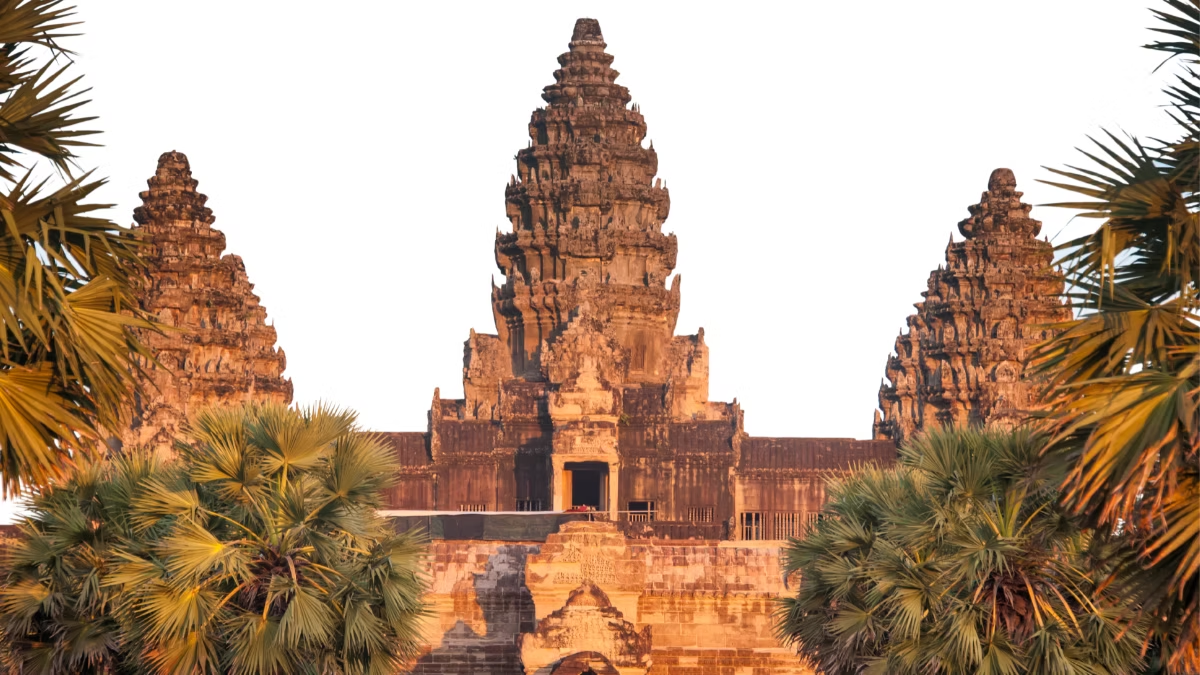
Angkor Wat Towers — The Central Sanctuary Explained

Angkor Wat has five towers arranged in a quincunx pattern — one central tower and four corner towers — representing the five peaks of Mount Meru, the mythological centre of the Hindu cosmos. The central tower rises 65 metres above ground level and was originally topped with gilded gold. The upper level (third tier) is accessible to visitors via steep stone stairs; wooden stairs with handrails have been installed at one access point. The views from the upper gallery are extraordinary, and the inner sanctuary contains active Buddhist shrines.
The five towers of Angkor Wat are the image that defines Cambodia on flags, banknotes, tourist posters, and every travel photograph ever taken from the north reflecting pool. But they are more than a silhouette. They are a three-dimensional theological statement — a physical map of the Hindu cosmos built to the proportions of mythological time, oriented to track the movements of the sun, and designed to convey, through architecture alone, the relationship between the divine and the mortal world.
Top Tickets
The Symbolism of the Five Towers
The five towers of Angkor Wat represent the five peaks of Mount Meru — the axis of the Hindu cosmos and the home of the gods. The central tower represents the highest peak; the four corner towers represent the four surrounding summits. The three-tiered base of the temple represents the three levels of the cosmos: the underworld, the earthly realm, and the divine realm. The moat surrounding the temple represents the cosmic ocean that encircles Mount Meru.
In Hindu cosmology, Mount Meru is the mountain at the centre of the universe — the home of Brahma and the other gods, surrounded by concentric rings of ocean and mountain ranges. Angkor Wat was designed to be a physical representation of this cosmological geography:
- The moat = the cosmic ocean surrounding Mount Meru
- The outer enclosure walls = the mountain ranges at the edge of the cosmos
- The three ascending tiers of the temple = the three levels of existence
- The five towers = the five peaks of Mount Meru
- The central tower (quincunx centre) = the highest peak, dwelling of Vishnu
This was not merely decorative symbolism. The Khmer kings were devarajas — god-kings — and their temples were literal residences of the divine on Earth. Angkor Wat was designed as the terrestrial home of Vishnu, and by extension as the place where King Suryavarman II would be apotheosised after his death.
The Architecture of the Towers
Each of the five towers (called prasats in Khmer) shares the same basic form: a square base rising through progressively receding tiers to a rounded finial at the top. This tower form — the shikhara in Sanskrit architectural terminology — was imported from South Indian temple architecture and adapted by Khmer builders into the distinctive lotus-bud shape that defines Angkor Wat’s silhouette.
The central tower (Bakan): The tallest and most sacred of the five, rising 65 metres above the ground. The sanctuary chamber at its base — a small room approximately 4 metres square — was the holiest space in the entire complex. It originally housed a statue of Vishnu (removed by the 13th or 14th century as the temple converted to Buddhist use). The current sanctuary contains a standing Buddha and several smaller images.
The four corner towers: Each rises to approximately 40 metres — significantly shorter than the central tower but monumental by any other standard. They mark the corners of the third-tier gallery and frame the central tower in every composition.
Original gilding: Historical and Chinese accounts indicate that the towers were originally gilded — covered in gold leaf or gold plate. The effect on the Angkor plain, visible for many kilometres, would have been extraordinary. The gold was stripped over centuries of conflict and instability.
Reaching the Upper Level — Practical Guide
The third tier and the base of the five towers are accessible to visitors. The climb requires ascending two staircases.
From the second level to the third level: Steep stone stairs on all four sides of the third-tier pyramid. The angle is approximately 50–55°. Wooden stairs with rope handrail have been installed on the north side of the west face — this is the recommended ascent route.
What to expect at the top: A square gallery at the base of the five towers, with doorways opening inward to the tower bases and outward to views over the Angkor plain. The inner sanctuary of the central tower is accessed from the west face.
Physical requirements: The stairs are steep enough that those with significant fear of heights, knee problems, or vertigo may find the descent difficult. Take your time, use the handrail, and descend facing the stairs (not facing away from them) on the steeper sections.
Shoe removal: Required before entering the inner sanctuary. Slip-on shoes or sandals are strongly recommended.
Crowd management: The upper level becomes crowded during peak hours (9:00 AM–12:00 PM). Arriving early (before 8:00 AM) or in the late afternoon (after 3:30 PM) gives a noticeably calmer experience.
Views from the Upper Level
The views from the third-tier gallery are among the most extraordinary in Southeast Asia. Looking west down the main causeway — the 350-metre straight line of sandstone, flanked by nāga balustrades, disappearing into the distant western gopura — provides the most complete understanding of Angkor Wat’s scale that any single viewpoint offers.
Looking north and south, the moat and the outer enclosure walls frame the temple on both sides. In the wet season (June–October), the moat is full and reflective; in the dry season, it is lower but still present. Looking east, the Angkor Thom road is visible in the distance.
The towers themselves, seen from the third-tier gallery, are no longer silhouetted against the sky but present in three dimensions — the carved stone surfaces, the receding tiers, and the lotus-bud finials all visible at close range.
The Towers in Morning and Afternoon Light
Sunrise (5:00–7:00 AM): The towers are seen from the west, silhouetted against the brightening eastern sky. The reflecting pool composition — towers reflected in still water — is captured at this time. The light on the towers themselves (their western face) is still in shadow; the photographic power is the silhouette and reflection.
Morning (7:00–10:00 AM): The eastern sun begins to illuminate the eastern faces of the towers while the western faces remain in partial shadow. Light enters the inner gallery from the east — the most beautiful interior light of the day.
Late afternoon (3:30–5:45 PM): The westering sun illuminates the main western façade directly — the towers glow amber-gold. This is the best time to photograph the towers from the causeway and reflecting pool positions. See the photography tips guide for full detail.
Frequently Asked Questions
How tall are the towers of Angkor Wat?
The central tower rises 65 metres above ground level. The four corner towers are approximately 40 metres. The towers were originally topped with gold — historical accounts describe them gleaming over the Angkor plain.
What do the five towers of Angkor Wat represent?
They represent the five peaks of Mount Meru — the mythological centre of the Hindu cosmos and the home of the gods. The central tower represents the highest peak; the four corner towers represent the surrounding summits. The entire temple is a physical map of the Hindu universe.
Can you go inside the towers at Angkor Wat?
The inner sanctuary at the base of the central tower is accessible — it is the primary worship chamber of the temple and contains active Buddhist shrines. The tower shafts themselves are not hollow and cannot be climbed inside.
Is the climb to the top of Angkor Wat worth it?
Yes — the views from the upper gallery over the Angkor plain and down the causeway are extraordinary. The experience of being at the base of the five towers and looking over the surrounding jungle is genuinely moving. The steep stairs are manageable for most visitors with reasonable fitness.
