
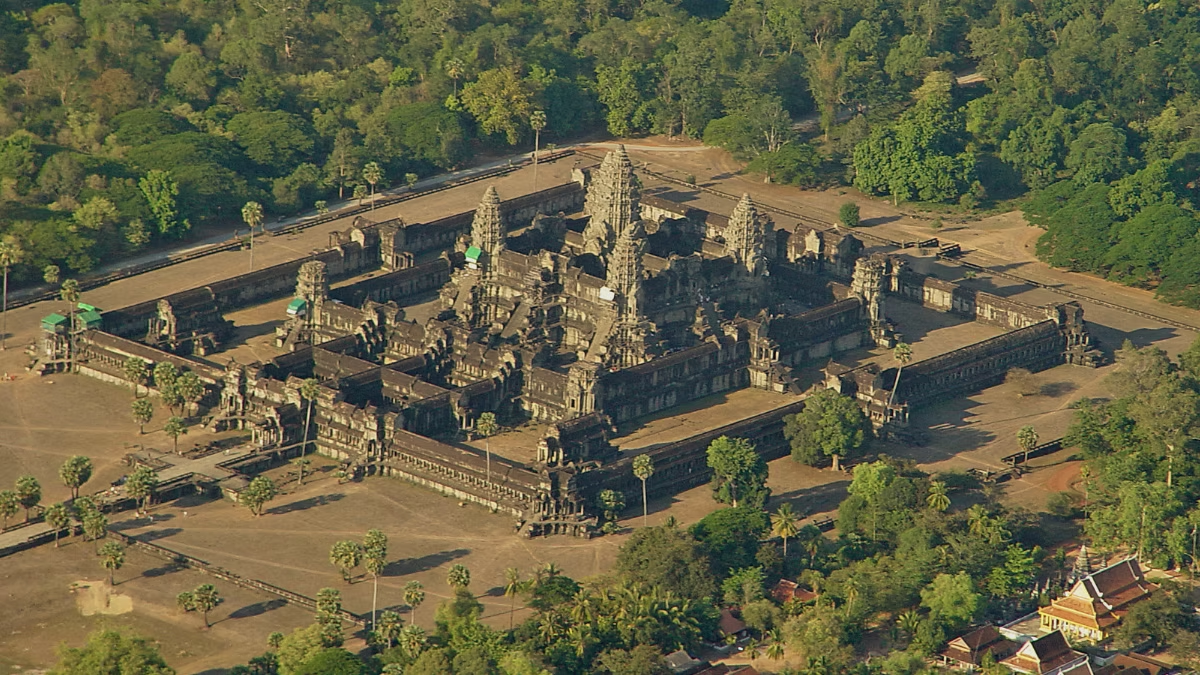
Angkor Wat History & Architecture — The Full Story

Angkor Wat was built in the early 12th century (c.1113–1150 CE) by King Suryavarman II of the Khmer Empire as a state temple and mausoleum dedicated to the Hindu god Vishnu. It is the world’s largest religious monument, covering 162 hectares within its moat. After the collapse of the Khmer Empire in the 15th century, it was never fully abandoned — Buddhist monks maintained the temple — and it was formally studied and restored by French colonial scholars from the late 19th century. Today it is a UNESCO World Heritage Site, managed by APSARA Authority, and the most visited attraction in Southeast Asia.
Understanding the history of Angkor Wat is not an academic exercise. It directly shapes what you experience when you walk through the temple — why the building faces west when virtually every other Khmer temple faces east, what the five towers represent, why the bas-reliefs tell the stories they tell, and why Buddhist monks are present in a temple built for a Hindu god. The history is embedded in every stone.
Top Tickets
The Khmer Empire — Context
To understand Angkor Wat, you need to understand the empire that built it.
The Khmer Empire (802–1431 CE) was one of the most powerful and extensive civilisations in Southeast Asian history. At its peak in the 12th and 13th centuries, it controlled a territory encompassing present-day Cambodia, much of Thailand, Laos, and southern Vietnam — an empire of perhaps five to ten million people governed from the Angkor region in northwestern Cambodia.
The Khmer kings were devarajas — god-kings. The political theology of the Khmer state held that the king was an earthly manifestation of a specific Hindu deity; his state temple was therefore both a royal palace in life and a divine residence after death. Every Khmer king of significance built a state temple as the physical embodiment of his divine identity.
Angkor Wat is Suryavarman II’s devaraja temple — the building through which he claimed divine status as an aspect of Vishnu, and within which he expected to be apotheosised after his death.
King Suryavarman II and the Decision to Build
Suryavarman II came to power in 1113 CE after a period of internal conflict. He consolidated the empire, expanded its territory (particularly into the territories of present-day Thailand and Vietnam), and chose the construction of a supreme state temple as the defining act of his reign.
The location chosen — the Angkor plain, already the site of earlier Khmer capitals and temples — had both practical and symbolic advantages: proximity to the Tonle Sap Lake (source of the rice production that fed the empire), access to water for the temple’s moat and reflective pools, and continuity with the sacred landscape established by his predecessors.
The temple was built largely between 1113 and 1150 CE — roughly 37 years of sustained construction requiring, by modern estimates, the equivalent of a million man-days of labour, hundreds of master stone carvers, and a vast logistics operation to transport the sandstone from the Phnom Kulen quarry approximately 40 km away.
The Architecture — What It Means
The Orientation — Why Angkor Wat Faces West
Almost every Khmer temple faces east — toward the rising sun, associated with life and fertility. Angkor Wat faces west — an orientation associated in Hindu cosmology with the setting sun, death, and the underworld.
The scholarly consensus is that this western orientation confirms Angkor Wat’s primary function as a funerary monument — a mausoleum for Suryavarman II. He was to be buried here, apotheosised as an aspect of Vishnu, and worshipped by his successors in perpetuity.
A secondary explanation, not incompatible with the first, is astronomical: at the spring equinox, the sun rises directly behind the western gopura when viewed from the east — creating a solar alignment that may have been central to the temple’s ritual calendar.
The Cosmological Plan
Every major element of Angkor Wat’s architecture carries cosmological meaning:
- The moat (200 metres wide): Represents the cosmic ocean that surrounds Mount Meru in Hindu cosmology.
- The outer enclosure walls: The mountain ranges at the outer edge of the cosmos.
- The three ascending tiers: The three levels of existence — underworld, earthly realm, and divine realm.
- The five towers (quincunx): The five peaks of Mount Meru — the mountain at the centre of the Hindu cosmos where the gods dwell. The central tower (the highest) represents the summit where Brahma and the principal gods reside.
- The main causeway (facing west): The path from the mortal world to the divine realm — a processional road linking the western (mortal) bank of the moat to the divine territory of the temple.
The Proportions — Encoding Time
The architectural proportions of Angkor Wat encode the four ages of Hindu time — the yugas. Scholars including Eleanor Mannikka have demonstrated that the key measurements of the temple (in the Khmer unit of measurement, the hat) correspond to the lengths of the four yugas as described in Hindu astronomical texts. The temple was thus designed not only as a map of space (Mount Meru) but as a map of time — the entire cosmic cycle expressed in stone.
Construction — How It Was Built
The sandstone blocks of Angkor Wat were quarried at Phnom Kulen mountain (identified with the sacred mountain Mahendraparvata), approximately 40 km to the northeast. They were transported to the building site by a combination of overland rollers and water transport — floated down canals connected to the Siem Reap River, then up a system of canals dug specifically for the construction.
The construction sequence began with the moat and outer enclosure, then progressed inward. The bas-relief panels were carved both before and after assembly — some blocks show carving on surfaces that would be inaccessible after placement, indicating pre-assembly carving; others show continuous carving across joints between blocks, indicating post-assembly work.
The master carvers who executed the bas-reliefs were almost certainly under the direction of a chief architect whose identity is unknown. Indian craftsmen or craftsmen trained in the South Indian tradition may have participated — the iconographic conventions of the carvings reflect South Indian Hindu temple art more closely than any earlier Khmer work.
The Religious Transition — From Hindu to Buddhist
Suryavarman II died c.1150 CE. The temple he built to Vishnu began its gradual conversion to Buddhist use within a century of his death, as subsequent Khmer rulers — most dramatically Jayavarman VII — favoured Buddhism over Hinduism.
The conversion was not abrupt. Over two or three centuries, the Vishnu images in the temple’s inner sanctuaries were removed or modified; Buddha images were introduced; Buddhist monks established a community within the complex. By the 15th century, when the Khmer capital moved south to Phnom Penh, Angkor Wat had already been a Buddhist temple for generations.
What this means for visitors: The inner sanctuary today contains active Buddhist shrines — flower offerings, incense, and monk residences. This is not anachronistic or inappropriate; it reflects the genuine 800-year evolution of the building’s use. Angkor Wat has been a Buddhist temple for longer than it was a Hindu one.
Abandonment and Rediscovery
With the fall of Angkor as a political capital in the 15th century (the result of Siamese military pressure and possibly environmental degradation of the water management system), the surrounding city was abandoned. Angkor Wat itself was never abandoned — Buddhist monks maintained it throughout. But the wider archaeological site became overgrown jungle, and the Khmer capital shifted south.
Portuguese missionaries encountered Angkor Wat in the 16th century and wrote accounts that circulated in Europe. By the 19th century, the French colonial presence in Cambodia made systematic study possible. French explorer Henri Mouhot’s widely read accounts (1860s) captured European attention and initiated the modern era of Angkor scholarship.
The French colonial EFEO (École française d’Extrême-Orient) began systematic study and conservation in 1907, constructing the first detailed plans, conducting the first archaeological surveys, and undertaking the initial clearance and consolidation work. The period of most intensive French restoration lasted from 1907 to 1972, when the Cambodian civil war forced a halt.
APSARA Authority and Modern Conservation
Since 1995, Angkor Wat has been managed by APSARA Authority (Authority for the Protection and Management of Angkor and the Region of Siem Reap), a Cambodian government body established by royal decree. APSARA oversees conservation, research, and tourism management across the entire Angkor Archaeological Park.
International conservation partnerships continue — the Japanese government has funded work on the western gopura; the German GACP (German Apsara Conservation Project) has focused on the apsara carvings; the World Monuments Fund, the Smithsonian Institution, and others have contributed expertise and funding.
The ongoing challenge: millions of annual visitors exert physical and atmospheric stress on the stone structure. The oils from skin contact, the vibration of footfall, and the humidity generated by large groups inside the galleries all contribute to surface deterioration. Visitor management, boardwalk installation over fragile stone floors, and restricted access to the most vulnerable areas are all ongoing APSARA responses.
Frequently Asked Questions
When was Angkor Wat built?
Approximately 1113–1150 CE, during the reign of King Suryavarman II of the Khmer Empire.
Why does Angkor Wat face west?
Most scholars believe the western orientation — unusual for Khmer temples, which typically face east — confirms that Angkor Wat was primarily designed as a funerary monument. West is associated with death and the underworld in Hindu cosmology. A secondary explanation is astronomical: the spring equinox sunrise aligns with the temple’s main axis when viewed from the east.
Who built Angkor Wat?
King Suryavarman II (reigned c.1113–1150 CE) of the Khmer Empire commissioned and directed the construction. The temple was built by Khmer engineers, carvers, and labourers, possibly with input from craftsmen trained in South Indian temple traditions.
Is Angkor Wat Hindu or Buddhist?
Both, sequentially. It was built as a Hindu temple dedicated to Vishnu. Over the following two centuries, as the Khmer Empire converted to Buddhism, the temple was gradually adapted for Buddhist use. It has functioned as a Buddhist temple for approximately 600 years and is an active Buddhist place of worship today.
How old is Angkor Wat?
Approximately 900 years old, built between 1113 and 1150 CE.
